
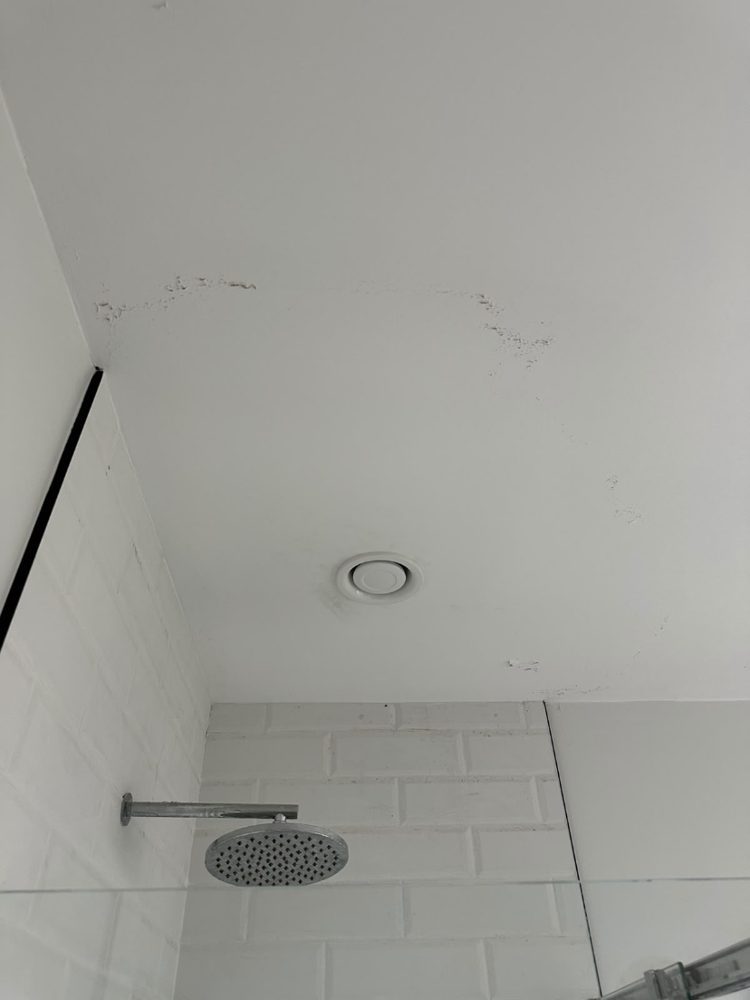
An inline bathroom extractor fan sits inside the duct, not in the bathroom wall or ceiling. The fan goes in the loft or a boxed void, and all you see in the room is a small round valve. It beats a wall or ceiling fan when the bathroom has to be quiet, when an ensuite sits next to a bedroom, when the shower is far from an outside wall, and when one fan has to extract from two points. It is the wrong choice when there is no loft or void, or when a short straight route to an outside wall already exists, because a good wall fan does that job for less. Our 2026 price to install an inline bathroom extractor fan is €600 to €700.
Key takeaways
- An inline fan is mounted in the duct, out of the room: a valve in the ceiling, a duct to the fan in the loft, a second duct from the fan to the outside.
- Choose it for a quiet bathroom, an ensuite beside a bedroom, a shower in the middle of the house, or two extract points on one fan.
- Skip it when there is no loft or void, when nobody could reach the fan later, or when the shower is beside an outside wall.
- The install decides how well it works: insulated duct through the cold loft, a terminal outside (never ending in the loft), access for servicing, and an overrun timer or humidity control.
- Our 2026 installed price is €600 to €700.
What is an inline bathroom extractor fan?
It is a fan built to sit in the middle of a duct run. The air goes in through a valve in the bathroom ceiling, up a duct to the fan in the loft or void, and out through a second duct to a terminal in the roof, the soffit or a gable wall. A wall fan has its motor in the outside wall of the room; a ceiling fan has it in the bathroom ceiling. With an inline fan the motor is above the ceiling, usually a few metres away, so the bathroom is quieter and the valve can go where the steam is made, not where the outside wall happens to be. If you are shopping rather than planning, the inline ventilation fans we supply are in our shop with prices.
When does an inline fan beat a wall or ceiling fan?
In four situations we meet all the time in Dublin homes.
When the bathroom has to be quiet
A wall or ceiling fan has its motor in the room, so you hear it every time the light goes on. Moving the motor into the loft takes most of that noise out of the bathroom, and a fan that is not annoying is a fan that actually gets used.
When an ensuite sits next to a bedroom
An ensuite fan that rattles after a late shower wakes whoever is asleep next door. With an inline fan the motor is out of both rooms. Where the loft allows, the fan is better placed over the bathroom or a landing than above the bedroom, and fixed to a timber rather than resting on the ceiling, so vibration does not carry into the room below.
When the shower is far from an outside wall
A wall fan has to go on an outside wall, often the wrong end of the room, so it pulls the steam across the ceiling and tiles before it leaves. An inline fan lets the valve sit straight over the shower while the duct takes the long way round in the loft. In a modern Dublin bathroom we upgraded, the old setup relied on natural ventilation and the steam just hung in the room; we fitted a proper extractor fan with the extract point in the ceiling, where the steam collects.
When you need to extract from two points
One inline fan can serve two extract points, such as a bathroom and the ensuite beside it, by joining two ducts before the fan. It then has to be sized for both rooms. Our bathroom extractor fan buying guide compares fan types, sizes and models.
A recent job: an inline bathroom fan in Terenure, Dublin 6W
The bathroom needed extraction right above the shower, where the steam is created, and it had to be quiet. A standard wall fan would have put the motor in the room, where it would be heard every time, and it would have pulled air from the wrong spot.
We installed an Air TS 150 Silent inline fan in the loft, away from the bathroom. In the room you only see a small round valve above the shower. We connected it with insulated ducting through the loft, so the warm air does not cool and condense on its way out.
The result: steam is pulled out at the source, the bathroom is quiet, and the duct route will not cause condensation or drips in the loft. Renovating in Terenure, Rathfarnham or Kimmage? Plan the bathroom ventilation before the tiles go on.
When is an inline fan the wrong choice?
When there is nowhere sensible to put it, or nothing to gain.
- No loft and no void. A ground floor bathroom under a bedroom, an apartment with a concrete ceiling or a flat roofed extension with no way in leaves the fan nowhere to live. A quiet wall fan is the answer or, where the room is cold as well as damp, a single room heat recovery unit.
- A short direct route outside. If the shower is close to an outside wall, a good wall fan does the same job with less ducting, less work in the loft and a lower price.
- No access later. A fan sealed into a void with no hatch cannot be cleaned or replaced without opening the ceiling.
- A whole house problem. If the bedroom windows and the landing run with condensation too, no bathroom fan will fix that on its own.
What does an inline fan installation involve?
A look at the route first, then five things that decide whether the fan keeps working or fails quietly in its first winter.
The duct route
Short, as straight as the loft allows, rigid or semi rigid where possible, and supported so it does not sag between the joists. On a survey our team checks where the duct can run without sharp bends or long cold stretches, and whether there is access, power and space for maintenance later.
The outside terminal, never the loft
The duct from the fan must end outside, through a roof vent, a soffit vent or a wall terminal. A duct that stops in the loft moves the moisture onto the roof timbers; our Malahide roof vent job shows what that looks like and how it is put right. The Building Regulations guidance on ventilation, Technical Guidance Document F, also expects extract air to go to the outside.
Condensation in the duct
Bathroom air is warm and wet, and a loft in winter is cold. In bare duct the moisture condenses inside, then runs back to the fan or drips through the ceiling. We use insulated duct wherever it crosses the cold loft, as in Terenure, and where the route allows we give the run a slight fall towards the outside so any water drains away from the fan.
Access for servicing
Out of sight is the point, but the fan still needs a clean now and then and, one day, a replacement. We place it where it can be reached from the hatch, on boarding or a bracket, never buried under insulation, with an isolator nearby. The wiring is connected by a competent person, and a qualified electrician is available if you prefer.
Control: overrun timer or humidity sensing
An overrun timer keeps the fan running for a set time after the light goes off. A humidity sensor starts or boosts it when the air gets wet, which suits a family bathroom because nobody has to remember. Decide which before the wiring goes in.
What does an inline fan cost to install in 2026?
Our 2026 price for an inline fan installation is €600 to €700. Where your bathroom lands depends on the length of the duct run, the outside terminal and how easy the loft is to work in. A standard new wall or ceiling fan is €450 to €550 installed, and replacing a fan in its existing position is €200 plus the fan; our guide to bathroom extractor fan replacement covers the signs that a fan has had its day. We confirm your figure in a free preliminary quote by email from photos and your Eircode. Where an on site survey is needed, it is charged, and we tell you before we come out.
Frequently asked questions
Can you hear an inline bathroom fan?
Much less than a wall or ceiling fan, because the motor sits in the loft or void, not in the room. You may hear a soft rush of air at the valve and, in a very quiet house at night, a faint hum. A fan fixed to a timber and a well supported duct keep that to a minimum.
Where should an inline extractor fan be installed?
In the loft or a ceiling void near the bathroom, where it can be reached from the hatch for cleaning and replacement. The valve goes above or beside the shower, where the steam is made. The fan must never be buried under insulation, and its duct must end outside, never in the loft.
How much does an inline bathroom fan cost to install?
Our 2026 price for an inline fan installation is €600 to €700, covering the work in the loft, the ducting and the valve in the room. The exact figure depends on the duct run, the outside terminal and the loft access, and we confirm it in a free preliminary quote by email.
Does an inline fan need maintenance?
A little. Dust and lint build up on the valve, in the duct and on the fan, and a fan choked with dust moves far less air. Wipe the valve regularly, and have the fan and duct checked if the bathroom starts staying steamy for longer than it used to. That is why access from the hatch matters.
Thinking about an inline fan for a quiet bathroom or an ensuite in Dublin and Leinster? Send us a few photos of the bathroom and the loft hatch with your Eircode and we will email a free preliminary quote within 24 hours, call (01) 685 6363, or use the form below.