
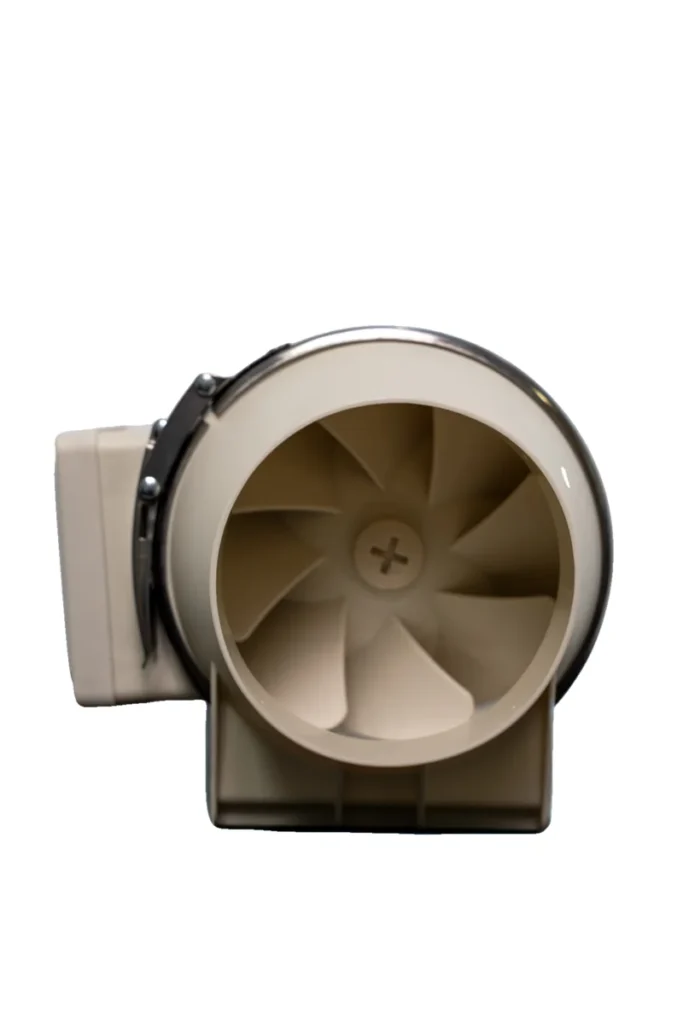
Most bathroom fans in Ireland were chosen by whoever built the house, and most of them are the cheapest axial fan that fitted the hole. That is why so many bathrooms have a fan that spins, hums and still leaves the mirror fogged twenty minutes after a shower. Choosing the right type costs little more and is the difference between a bathroom that dries and one that grows mould in the ceiling corners. This guide walks through the four types we fit, what each one is for, how to size it, what it costs supplied and fitted in 2026, and the mistakes that make a good fan useless.
Key takeaways
- There are four types that matter in a home: axial (the standard wall or ceiling fan), centrifugal (quieter and able to push through longer ducts), inline (the motor sits in the attic or ceiling void, so the bathroom only shows a grille), and continuous running fans with humidity tracking (always on at a trickle, boosting by themselves).
- Size by the room: a typical Irish bathroom needs eight to ten air changes an hour. A four by two metre bathroom with a 2.4 metre ceiling is about 19 cubic metres, so it needs roughly 150 to 190 cubic metres an hour. A 110 cubic metres an hour axial fan is fine for a small en suite, not for a family bathroom with a long duct.
- Noise is where cheap fans lose: an axial fan sits at about 34 dB(A), a good inline fan from 22 dB(A), and a continuous running centrifugal fan can be close to silent on trickle.
- Our 2026 installed prices: replacing a fan in the existing position is €200 plus the fan, a new standard bathroom fan is €450 to €550 installed, and an inline fan installation is €600 to €700. Supply only prices run from €49 for a basic axial fan to €219 for a continuous running unit.
- If the bathroom has no duct route to the outside, or the whole house suffers condensation, a fan is the wrong tool. A single room heat recovery unit through the wall or a whole house system is the honest answer.
The four types, and where each belongs
Axial fans: the standard fan, for short straight ducts
An axial fan is a propeller in a tube. It moves a lot of air when there is almost nothing in its way, which is why it works well straight through an external wall. Put three metres of flexible duct and two bends behind it and the airflow collapses, because an axial fan has very little pressure behind it. Ours is the Air BV 100: 100 millimetre, 110 cubic metres an hour, 34 dB(A), 7.5 watts, €49 supply only, or €59 for the Air BV 100 T with an overrun timer that keeps it running after the light goes off. Right for a small en suite or toilet on an outside wall. Wrong for an internal bathroom with a duct to the roof.
Centrifugal fans: for internal bathrooms and longer ducts
A centrifugal fan works like a hairdryer: it builds pressure, so it keeps pulling air through a longer or bent duct where an axial fan gives up. That makes it the fan for a bathroom in the middle of the house. The EBB-N 100 (€179) moves 70 or 110 cubic metres an hour at 34 to 44 dB(A). The EcoAIR DESIGN S (€159) and DESIGN H (€179) are constant volume centrifugal fans: they hold their set airflow against duct resistance, run at up to 32 dB(A) on 7.2 watts, and the H version adds a humidity sensor and timer so it boosts itself after a shower. Flat fronted, so they sit neatly on a wall or ceiling.
Inline fans: the quiet option, with only a grille in the room
An inline fan is mounted in the attic or ceiling void, with a duct from the bathroom grille to the fan and another from the fan to the outside. The motor is out of the room, so the bathroom is quiet and the ceiling shows only a flat valve. Inline fans are also the most powerful option: the Vents TT 100 (€99) moves up to 187 cubic metres an hour at 27 to 36 dB(A), the Vents TT 150 (€139) up to 520 cubic metres an hour for larger rooms or two bathrooms on one fan, and the Air TS 100 Silent (€179) is the quiet one at 240 cubic metres an hour from 22 dB(A). This is the fan we recommend for most family bathrooms with an attic above, and for anyone who has given up on a noisy ceiling fan. The installed price is higher (€600 to €700) because of the ducting and the work in the attic.
Continuous running fans with humidity tracking: the fix for a mouldy bathroom
Where a bathroom has already had condensation or mould, an on and off fan is often not enough, because the damp air sits in the room between showers. A continuous running fan runs all the time at a low trickle, almost silently, and boosts by itself when its humidity sensor sees a shower or steam. The Envirovent Filterless Fan (€219) has no filter to clog, tracks humidity as standard and runs at 28 watts on boost; the S&P EcoAIR EVO HT (€189) draws 2 to 4.5 watts and runs between 9 and 34.6 dB(A) with a three year warranty. These are the fans we fit after a mould treatment, because they remove the cause rather than the symptom.
How to size a bathroom fan
Measure the room: length by width by ceiling height gives cubic metres. Multiply by eight to ten air changes an hour to get the airflow you need in cubic metres an hour. Then take the duct into account: every metre of flexible duct and every bend costs airflow, so a fan that is rated at 110 cubic metres an hour on the box may deliver half of that at the end of a three metre run. Two rules of thumb we use on site: if the duct is longer than about a metre or has a bend, choose a centrifugal or inline fan; and if the room is a family bathroom rather than an en suite, start from 150 cubic metres an hour, not 110.
Noise: what the numbers mean
A fan is used in a room where people want quiet. Decibel figures on product pages are measured at a set distance and are not perfectly comparable between brands, but the ranges are honest: 34 dB(A) is a standard axial fan you clearly hear; 22 to 27 dB(A) is a quiet inline fan you notice only in silence; 9 to 19 dB(A) on trickle is a continuous running fan you forget is there. If noise is the complaint that brought you here, an inline fan or a continuous running centrifugal fan is the answer, not another axial fan.
Timers, humidity sensors and switches
An overrun timer keeps the fan running for a set time after the light goes off, which clears a bathroom after a short visit. A humidity sensor starts or boosts the fan when the air gets wet, which is the right control for a shower room, because nobody remembers to switch a fan on. A pull cord or separate switch lets you override it. Our advice: for a toilet, a timer is enough; for any room with a shower or bath, choose humidity sensing.
What it costs in 2026
| Job | Our installed price | Typical fan (supply only) |
|---|---|---|
| Replace a fan in the existing position, same duct and wiring | €200 plus the fan | Air BV 100 T €59, EBB-N 100 €179, EcoAIR DESIGN H €179 |
| New standard bathroom fan (new opening or new wiring) | €450 to €550 | EcoAIR DESIGN S €159, S&P EcoAIR EVO HT €189, Envirovent Filterless €219 |
| Inline fan installation (fan in the attic, ducting, grille) | €600 to €700 | Vents TT 100 €99, Air TS 100 Silent €179, Vents TT 150 €139 |
We confirm the figure for your bathroom in a free preliminary quote by email once we have a photo and your Eircode. The signs that a fan needs replacing, and what we do on the day, are in our guide to bathroom extractor fan replacement in Dublin.
The mistakes that make a good fan useless
- A crushed or kinked flexible duct behind the fan. The fan runs, nothing leaves the house. We replace flexible duct with rigid where we can.
- Venting into the attic instead of outside. The moisture moves from the bathroom to the roof timbers. Every fan we fit terminates outside through a wall, soffit or roof vent.
- No make up air. A fan can only extract what can get in. A bathroom door with no gap under it and no trickle vent starves the fan.
- The wrong fan for the duct run. An axial fan on a long duct is the most common reason a new fan “does nothing”.
- Switching it off. A fan that is never used dries nothing. Humidity sensing removes the decision.
When a fan is not the answer
If there is no route to the outside from the bathroom, a single room heat recovery unit fitted through an external wall ventilates the room continuously while keeping most of the heat. If the condensation is on the bedroom windows and the landing as well as in the bathroom, the house needs whole house ventilation rather than a better bathroom fan; our bathroom ventilation system page explains the options.
Frequently asked questions
What type of extractor fan is best for a bathroom?
For a bathroom on an outside wall with a short straight duct, a quiet axial or centrifugal fan with a humidity sensor. For a bathroom with a long duct, an attic above or a noise complaint, an inline fan. For a bathroom that has had mould, a continuous running fan with humidity tracking.
What is the best extractor fan for bathrooms?
There is no single best fan, because the duct run decides. On our installs the fans that get the fewest call backs are the inline Vents TT 100 and Air TS 100 Silent for family bathrooms, and the Envirovent Filterless or EcoAIR EVO HT where damp has been a problem.
Do I need an electrician to install an extractor fan in my bathroom?
A fan connected to the mains in a bathroom zone must be wired by a competent person. Our installers fit and connect the fan as part of the job; a like for like replacement on the existing wiring is the simplest case.
Can I replace a bathroom extractor fan myself?
Swapping a plug in fan for the same model is a short job for a handy person. Anything that changes the wiring, the opening or the duct is work for an installer, and the duct is usually where the problem is.
Is an inline extractor fan better?
For most family bathrooms, yes: it is quieter in the room, moves more air and copes with longer ducts. It costs more to install because of the attic work.
Do inline duct fans run all the time?
Only if you choose a continuous running model or wire it that way. Standard inline fans run with the light or a humidity sensor and switch off after the overrun.
Send us a photo of the bathroom and your Eircode and we will email a free preliminary quote within 24 hours, or call (01) 685 6363.