
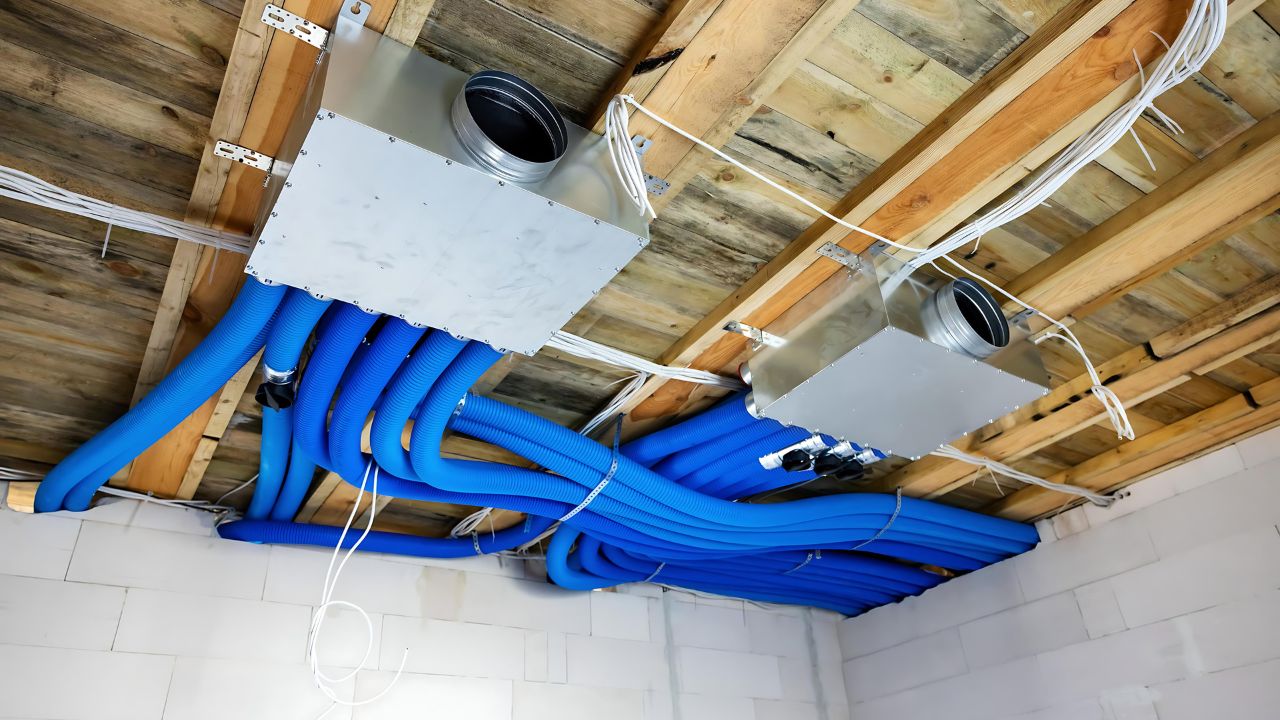
Mould in new build homes with MVHR usually comes from two things working together: the house is still drying out, and the ventilation is not running the way it was designed to. A new home holds water from its plaster, screed and blockwork, and that water leaves as vapour over the first one or two winters, into a house that is airtight by design. MVHR can carry it away, but only if the system was balanced at handover, is left running, has clean filters and is boosted for showers and cooking. None of this means the house was badly built. Where the mould keeps coming back, a mould survey in Dublin finds the reason before money goes on the wrong fix.
Key takeaways
- A new house gives up water from its plaster, screed and blockwork over the first one or two heating seasons. That is normal.
- MVHR is designed to run all the time. Switched off, turned down because of noise or never balanced, it cannot carry that moisture away.
- Clogged filters, closed or painted valves, an unused boost setting and furniture tight against outside walls are the everyday causes.
- Check the controller, filters, valves and corners yourself first; a commissioning visit or a service restores the design airflow.
- If mould returns after cleaning, the house smells musty or several rooms are affected, book a survey before you redecorate.
Why does a new house have so much moisture in it?
Because it was built wet. Plaster goes on wet, screeds are poured wet and blocks are laid in wet mortar, and much of that water is still in the structure when the keys are handed over. As it dries, it adds to everything a household produces each day from showers, cooking, drying clothes and breathing.
Unlike an older, draughty house, a modern A-rated home is sealed to keep the heat in, so the only planned way out for that moisture is the ventilation. That makes the first winter the hardest: the building is still giving up water, and the outside walls, window reveals and corners are at their coldest. Moist air meets a cold surface, condensation forms, and a surface that stays damp for long enough grows mould.
On a return visit to a new build in Dublin 6W, the protective film was still on the windows and the plaster was still drying. We were there to check and complete our part of the installation: a Vent-Axia Econiq heat recovery unit in its own space in the eaves, the controller on the wall beside it, insulated ducting through the roof structure and the valves in the rooms, with the unit kept accessible for filter changes. A house at that stage will still be giving up its plaster moisture when people move in, which is why the system has to be finished and running from the first day. Still at the drawing stage? Our guide to planning ventilation in a new build covers the decisions to make first.
Was the system balanced and commissioned at handover?
Check this first, because a system that was fitted but never balanced is ventilating the house by guesswork. Commissioning means measuring the airflow at every valve and setting the system so the air extracted from the kitchen, bathrooms and utility matches the fresh air supplied to the bedrooms and living rooms. On a new build it is the last step, after the plasterers, painters and floor fitters, so it is the one most easily left for later in a busy handover. Nobody has to have cut a corner for it to be missed.
Péter’s post from an apartment in Lucan shows what that looks like: filters that were meant to be white, valves that needed cleaning, and airflow that had to be calculated so the system could be commissioned and certified. With blocked filters and dirty valves, he wrote, the system stops moving the air it was designed for: wet windows in the morning, a stale smell and a steamy bathroom.
Look in your handover pack for a commissioning record with the measured flow at each valve. If there is none, a commissioning visit is the first thing to arrange. Our MVHR installation and commissioning page explains how we do it and hand over the figures.
Five everyday habits behind mould in new build homes
Five habits cause most of the new build mould we are called about, all of them easy to reverse.
Switched off or turned down because of noise. MVHR is meant to run all the time. If it hums or whistles, people turn it to the lowest setting or switch it off at the isolator, and the airtight house is left with no planned way to lose moisture. Noise is a sign that something needs checking, such as a blocked filter or a valve in the wrong position.
Filters never changed. As the filters clog, the fans move less air. As Péter put it on another job, if you cannot remember the last filter change, it is due.
Boost not used. Boost (a wall switch, a controller button or a humidity sensor, depending on the unit) raises the extract while the shower runs or the dinner cooks. Use it every time and leave it on for a while after. Dry clothes in a dryer or a room with an extract valve, not on the radiators.
Extract valves closed or covered. The round valves in the ceilings were set during commissioning. Twisted shut because of a draught, covered during decorating or painted over, each one throws the whole system off balance. Keep them dusted and leave the setting alone.
Furniture against cold corners. A wardrobe tight against an outside wall or a headboard in an external corner leaves a pocket of still, cold air where the wall never dries, and that is often where the first black spots appear. Leave a hand’s width behind furniture on outside walls.
What you can check yourself this week
Ten minutes with a stepladder and a torch tells you most of what you need to know.
- Is the unit on its normal setting, with no warning or filter light?
- Are the filters grey or black? If the manual shows how to open the unit, look.
- Does a tissue held just below each extract valve in the kitchen, bathrooms and utility get drawn gently towards it?
- Are any valves closed, painted, taped or thick with dust?
- Is boost used for every shower and every cooked meal?
- Pull furniture away from the outside walls. Clean any small spots on paint or tiles with a fungicidal mould cleaner, gloves and an open window, and watch whether they return.
What a return visit or a service fixes
A service brings the system back to the airflow it was designed for, and a commissioning visit sets that airflow properly if it was never done. We check the unit and the controller settings, replace the filters, clean the valves, check the condensate drain, measure the flow at every valve, balance supply against extract and make sure boost works. If noise was why the system was turned down, we look for the cause. Our post on five signs your MVHR needs maintenance lists the warning signs. For systems we install, servicing matters for the warranty too: we provide a 5 year warranty on MVHR units, provided that the system is serviced annually by VentSolve throughout the warranty period.
A service does not undo mould that has already grown; that still needs cleaning or treatment.
When to get a mould survey
Book a survey when the checks and a service have not solved it, and before you redecorate. The clearest signs:
- mould comes back within weeks of cleaning
- the house smells musty but nothing is visible
- mould is in several rooms, or on a wall that is not a cold corner, which can point to a cause other than ventilation, such as a slow leak
- you suspect the ventilation itself, as the title of Lénárd’s short video from his new build surveys, Mould Found in New Build Ventilation System, suggests
- someone in the home has asthma or another chest condition
- you need the cause and the extent in writing.
Our guide to what happens during a professional mould survey walks through the moisture readings, the ventilation check and the report.
When the mould needs removing
Growth that keeps returning, covers a large area or has got into plasterboard or fitted furniture needs professional mould removal, with the ventilation sorted in the same job, because cleaning alone only resets the clock. Our mould removal starts from €350 depending on size and scope, and we provide a 1 year warranty on our mould remediation work when the customer accepts and completes the full recommended quotation and scope of works. Do not paint over it: paint on a damp new wall hides the growth and traps the moisture still leaving the plaster. We work across Dublin and Leinster.
Frequently asked questions
Is it normal to find mould in a new build?
It is not unusual in the first winters, and it rarely means the house was badly built. The building is still drying out and it is airtight, so everything depends on the ventilation running as designed. In our experience it settles once the system is set up properly, small spots are cleaned early and the building has dried out.
How long does a new house take to dry out?
Usually the first one or two heating seasons, depending on how wet the building was, when it was finished and how well it is heated and ventilated. A house finished in autumn and lived in straight away tends to have the hardest first winter.
Should I switch my MVHR off if it is noisy?
No. With the system off, an airtight house has no planned ventilation, which is how condensation and mould start. A properly set up system should be close to silent in the bedrooms, so noise usually means something needs attention: a clogged filter, a fan speed set too high, a valve in the wrong position or a loose part. Get it checked instead.
How often should MVHR filters be changed?
Follow the interval in your unit’s manual, and check them more often in the first year, when fine building dust can clog them faster. A full service once a year covers the filters, valves, drain and measured airflow, and for systems we install it keeps the 5 year warranty valid.
Do I need a dehumidifier if I have MVHR?
Not normally. A working MVHR system is designed to handle the everyday moisture of a household. In the first winter of a new build, a dehumidifier in a room that is struggling can help the building dry out, but it supports the ventilation rather than replacing it. If you need one running all the time, the system needs checking.
Send us a few photos of the mould and of your MVHR controller with your Eircode through the form below, and we will email a free preliminary quote within 24 hours, or call (01) 685 6363.