
If your bathroom is still steamy with the fan on, the fan is running but the wet air is not leaving the house. On our jobs around Dublin the cause is usually one of eight things, and most of them you can check yourself in ten minutes with a torch and a sheet of toilet paper. Below is how to spot each one and what fixes it, with the 2026 prices from our bathroom extractor fan installation and replacement service.
Key takeaways
- A fan that spins is not always a fan that extracts. The toilet paper test at the grille tells you in seconds.
- A good fan clears the steam from a normal shower within minutes. If the mirror is still fogged ten minutes later, something below is wrong.
- The duct matters as much as the fan: a new fan on a crushed, dusty or disconnected duct is no better than the old one.
- Check the free things first: the gap under the door, the outside cover, and whether the fan runs on after the light goes off.
- Our 2026 prices: fan replacement €200 plus the fan, new standard fan €450 to €550, inline fan €600 to €700.
A ten minute check you can do yourself
Run the fan with the bathroom door shut, then:
- Hold a sheet of toilet paper against the grille. A working fan holds it flat.
- Try again with the door open. If it only holds now, the room is starved of air.
- Switch the light off. If the fan stops at once, it has no overrun.
- Find the outlet outside. You should feel air moving, and on many covers you will see the flaps lift.
- If your loft has safe boards to stand on, follow the duct with a torch to where it ends. If not, leave that step to us.
- Time the mirror after a normal shower.
Is the fan too weak for the shower?
Often, yes. Many bathrooms still have a small fan fitted for a basic shower that cannot keep up with a pumped shower, back to back family showers or a bigger room after a renovation. Fans also weaken with age.
How to spot it: the paper test is weak even with the door open, the duct looks sound, and the fan is old, loud or rattling.
The fix: a stronger fan in the same opening, on the same duct and wiring, which is a fan replacement at €200 plus the fan. Our guide to bathroom extractor fan replacement in Dublin covers the day itself, and the bathroom extractor fan buying guide explains which type copes with a bigger room or a longer duct.
Is the duct long, kinked, crushed or choked with dust?
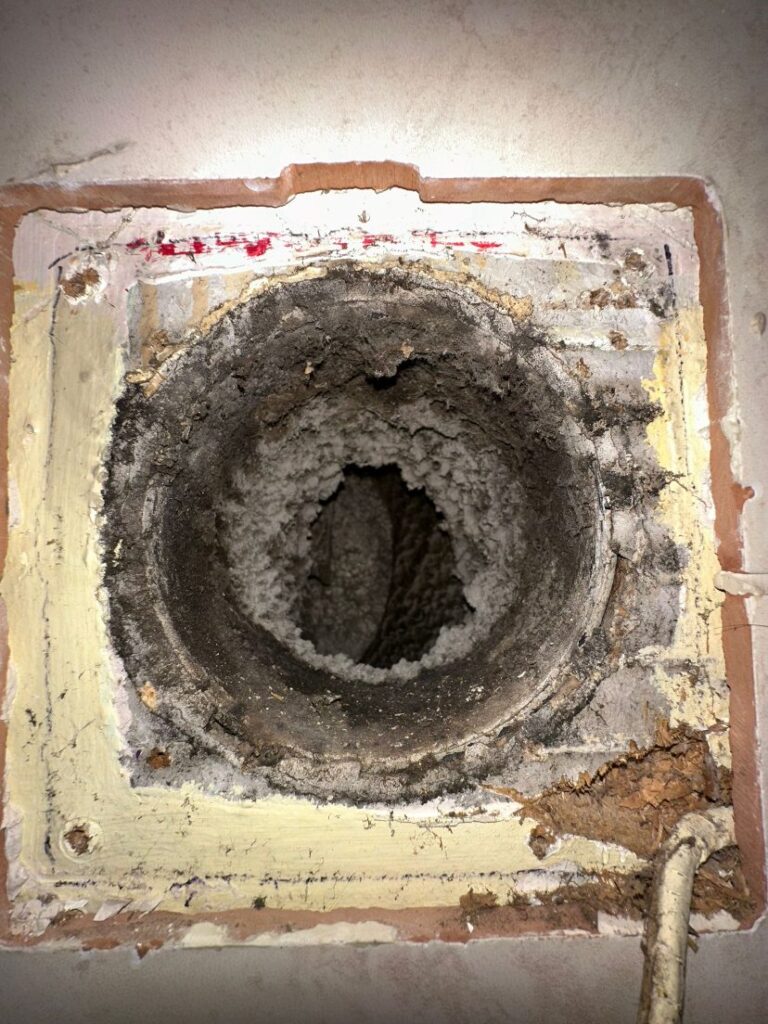
This is the cause nobody sees. Every metre of loose flexible duct, every sharp bend and every sag costs airflow, a squashed duct passes very little, and years of damp air line a duct with dust and lint, like the one in the photo at the top of this post. In Dublin 7, near the Phoenix Park, we replaced two tired fans and checked the ducts behind them as part of the brief. That is always worth doing: a new fan on a crushed, disconnected or uninsulated duct will still leave the bathroom steamy. We bring insulated ducting on jobs like that, so an old duct can be replaced on the same visit.
How to spot it: in the loft, look for long stretched runs, tight bends, flattened sections, joints that have pulled apart and bare duct in a cold loft. A torch through the grille often shows grey fluff inside the opening.
The fix: shorten and straighten the run, replace the bad sections, insulate the duct through the loft, and for a long run fit a fan built to push air through it.
Does the duct end in the loft?
Sometimes it does, and then the fan only moves the steam into the roof space, where it condenses on cold timber and felt. We told the full story of a roof vent job in Malahide where the fan was venting into the loft.
How to spot it: the duct stops in the loft, or there is no outlet outside in line with the bathroom. Damp rafters or black spots on the felt confirm it.
The fix: connect the duct to a roof vent, soffit vent or wall terminal, sealed against the weather and insulated through the loft.
Is the backdraught shutter stuck?
On older fans it often is. The shutter, behind the grille or in the outside cover, should open when the fan blows and close to keep the weather out. Dust, grease, paint or a bent flap can hold it shut, so the fan blows against a closed door. On a replacement in Malahide the old fan had reached the end of its life, and that is the typical pattern: older fans lose power, bearings wear and backdraught shutters stick.
How to spot it: nothing moves at the outside cover while the fan runs. A cold draught through the grille when the fan is off is the opposite fault: a shutter stuck open or a broken cover.
The fix: a new outside cover, or, if the shutter inside an old fan has seized, a new fan at €200 plus the fan.
Can replacement air get into the bathroom?
Not if the door closes tight to the floor. Every bit of air the fan sends outside has to come in from the rest of the house, normally under the door. New flooring or a tight new door closes that gap and the fan just labours.
How to spot it: the paper holds with the door open and drops with it shut, or the mirror clears faster with the door ajar.
The fix: the cheapest on this list, a clear gap under the door or a small grille low in it. No new fan fixes this one, so check it before you blame the fan.
Does the fan stop the moment the light goes off?
Then it switches off while the room is still full of steam. A fan wired to the light only runs while someone is in the room, which is how a bathroom with a working fan still gets black spots in the ceiling corners.
How to spot it: switch the light off after a shower and listen.
The fix: a fan with an overrun timer, or, better for a shower room, a humidity sensing fan that starts by itself when the air gets wet and stops once it is dry. In the same position that is €200 plus the fan, provided the existing wiring can feed the new fan; if it cannot, we say so in the quote.
Is the grille in the wrong place?
In older bathrooms it often is. The extract point belongs where the steam is made: high up, above or beside the shower or bath, and away from the door. A fan over the door pulls air in from the landing and leaves the steam in the shower corner. In Malahide we mounted the new fan high on the wall where the steam collects, so the air sweeps across the room before it leaves.
How to spot it: the ceiling over the shower drips while the area near the fan stays clear.
The fix: moving the fan to a new position is a new standard fan at €450 to €550. With a loft above, an inline fan with a small valve directly over the shower is €600 to €700; our post on planning ventilation for a bathroom renovation shows how we place it.
Is there only a natural vent?
Then nothing is pulling the steam out. A window or a wall vent lets some air move, but on a cold, still day with the window shut the wet air stays put. One modern Dublin bathroom we worked on, with grey tiles, a walk in shower and recessed lights, relied on natural ventilation: the steam hung in the room and settled on the ceiling, the tiles and the silicone, which is how black grout, bubbling paint and mould start. We fitted a proper extractor fan with the extract point in the ceiling where the steam collects, and the room now dries quickly after every shower.
How to spot it: there is no fan, or the grille on the wall is a passive vent with nothing behind it.
The fix: a new standard fan, €450 to €550 installed. Natural ventilation alone is rarely enough for a bathroom with a powerful shower.
When the steam has already left its mark
Fixing the cause stops new damage but does not remove what is already there. A small patch on a hard surface can be cleaned at home; mould that has spread into plaster, sealant or across the ceiling needs our bathroom mould removal service, from €350 depending on size and scope. We look at the fan on the same visit, because mould treated with the cause left in place comes back.
Frequently asked questions
Why is my bathroom still steamy with the extractor fan on?
Because the fan is running but the wet air is not leaving the house. The usual culprits are a weak fan, a bad duct, a duct ending in the loft, a stuck shutter, no gap under the door, no overrun, a grille far from the shower or no fan at all. The paper test and a look in the loft narrow it down quickly.
How long should a bathroom fan take to clear the steam?
A good fan clears the steam from a normal shower within minutes, with the door shut. If the mirror is still fogged ten minutes after you finish, the fan is not moving enough air out of the house and one of the causes above is at work.
Should I leave the bathroom door open after a shower?
Leaving it ajar helps the fan when the door has no gap underneath, but it also lets steam drift into colder bedrooms, where it ends up as condensation on the windows. The better answer is a gap under the door or a small grille in it, with the door shut and the fan running on.
Will a new fan fix a steamy bathroom?
Only if the fan was the problem. A new fan on a crushed or dusty duct, on a duct that ends in the loft, or in a room with no gap under the door leaves the bathroom as steamy as before. That is why we check the duct on every replacement.
Not sure which one it is? Send us a photo of the fan, one of the outside wall and, if you can, one of the duct in the loft, with your Eircode, using the form below, and we will email a free preliminary quote within 24 hours, or call (01) 685 6363. We work across Dublin and Leinster from our base in Dublin 15.