
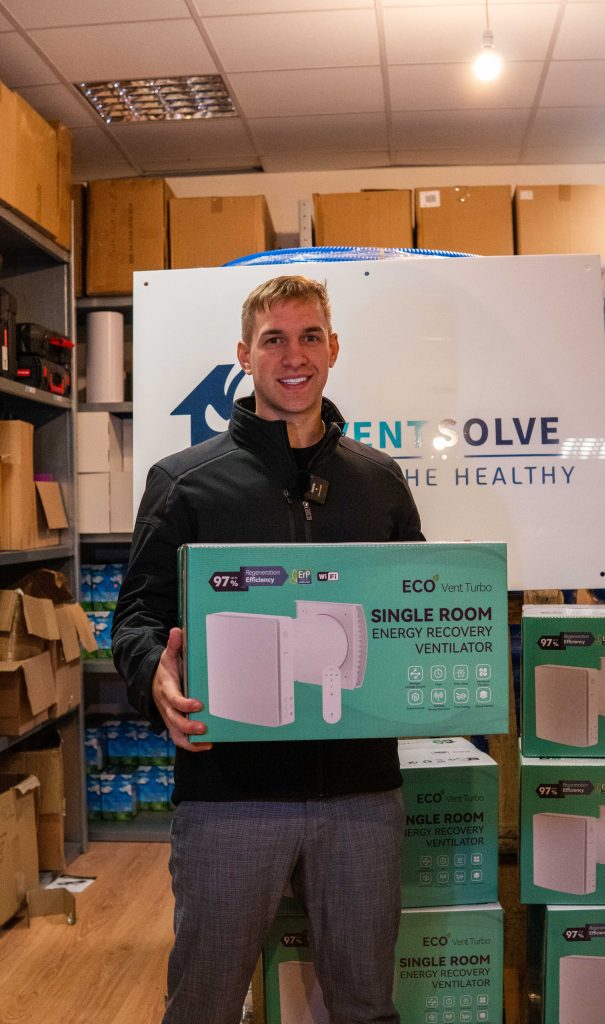
A single room heat recovery unit is a small reversing fan and a ceramic core in a round sleeve through an outside wall, and it works by breathing out and in. For a minute or so the fan pushes warm, damp air out through the core, and the ceramic soaks up the heat. Then the fan reverses and draws fresh outdoor air in through the same warm core, so it reaches the room warmed, not as a cold draught. Back and forth, all day, quietly. The moisture leaves while much of the heat stays, which is why a single room heat recovery unit is so often the answer for one or two problem rooms in a house with no route for ducting. We fit them across Dublin and Leinster; this is how they work.
Key takeaways
- The unit is a reversing fan, a ceramic honeycomb core and a filter in a sleeve through the outside wall.
- The core stores heat from the air going out and gives it to the air coming in; the fan swaps direction every minute or so.
- One unit on its own breathes out and in through the same hole. Two linked units run in opposite directions, one supplying while the other extracts.
- Heat recovery mode is the normal setting; ventilation mode, speeds, a night setting, humidity sensing and an app vary by model.
- It suits problem rooms, apartments, extensions and retrofits where ducts cannot go. When the whole house is damp, whole house MVHR is usually better.
What is inside a single room heat recovery unit?
From the outside in, the parts are simple. A grille or hood on the outside wall keeps out the rain. A round sleeve, set into a core drilled hole, carries the unit through the wall. Inside the sleeve sits the ceramic core: a round disc that looks like honeycomb, with a great many small channels running straight through it. Next to it are a filter that catches dust and pollen, and a small fan that can spin in either direction. On the room side a slim cover hides it all, with the controls on the unit, a remote or a phone app.
The honeycomb disc is the heart of the unit; everything else just moves air through it. The units we supply are listed in our single room heat recovery ventilation range.
How does the ceramic core keep the heat?
It works like a tiny storage heater that charges and empties over and over. Ceramic holds a lot of heat for its size and is not bothered by damp air, and the honeycomb gives the air a large surface in a very small space.
- Out: warm room air passes through the core and hands its heat to the ceramic, so it leaves cooler and the core warms up.
- Switch: after a set time, a minute or so depending on the model, the fan stops and reverses.
- In: cold outdoor air is drawn through the warm core and picks up the stored heat, so it enters the room warmed and the core cools.
- Repeat: the fan reverses again, all day and all night.
Because one core does both jobs, the unit fits in a single hole in one wall. How much heat it keeps depends on the model, the fan speed and the weather, so we do not quote one figure here; the maker’s data sheet gives it for each unit.
How does it take moisture out of the room?
By swapping the air, not by drying it. A lived in room fills with water vapour from breathing, cooking and clothes drying on the radiator. That damp air goes out on the extract half of the cycle, and the air that replaces it comes from outside: cold outdoor air carries far less water than the warm air of a closed bedroom. Running steadily, the unit keeps that swap going, so the moisture leaves before it settles on the window glass and the corners of the outside wall. An open window does the same swap but throws the heat away, so in an Irish winter nobody leaves it open long enough.
Do single room units work in pairs or on their own?
Both. On its own, one unit alternates, out through the hole and then back in, so the air moves in pulses. That suits many single rooms, such as a box room or a small bedroom.
In a pair, two units are linked, by a control cable or wirelessly depending on the model, and run in opposite directions: while one extracts, the other supplies, then both reverse together. The air going out matches the air coming in and the flow is steady. Pairs suit a larger room, an open plan living area or two neighbouring rooms.
What do the modes do?
Names vary from maker to maker, but most units offer the same few settings.
- Heat recovery mode: the reversing cycle above. This is the setting for most of the year, and the one to leave it on all winter.
- Ventilation mode: the fan runs one way without reversing, so no heat is recovered. Useful on a warm summer night to bring cooler air in; in winter it simply lets the cold in. Some models also run supply only or extract only.
- Speeds and boost: usually low for the night, middle for the day, and boost for a short spell after a shower or while clothes dry.
- Night setting, humidity sensing and app control: on models that have them, a sensor steps the speed up when the room gets damp, and a Wi-Fi unit takes schedules from your phone. Our guide to setting schedules and features on a single room heat recovery unit walks through the app.
Where does a single room unit suit best?
In the rooms that have the problem, in a house that otherwise works: a bedroom with streaming windows every morning, a box room on a cold outside wall, a living room with black spots in the corners. It suits retrofits where ducts cannot run through finished ceilings, apartments with an outside wall but no attic (the management company may need to approve the opening and the grille, so ask first), extensions and attic conversions, and a landlord fixing one damp bedroom without a building project.
It needs an outside wall with a clear position away from furniture, nothing inside the wall where the hole goes, and a power supply close by. The moisture source matters too: with a dead bathroom fan, the unit next door is fighting a losing battle. The everyday gains, from fresher air to drier windows, are in our post on the benefits of single room heat recovery.
A real job: bedrooms in Arklow, Co. Wicklow
In Arklow we supplied and fitted heat recovery units in a home where the bedrooms were the problem. Two people sleeping in a closed room release a lot of moisture overnight: open the window and the heat goes, keep it shut and the moisture lands on the glass and the coldest wall. The homeowner wanted fresh air without ducting the whole house. We core drilled through the external wall, fitted the units with an inline section in the loft, and added sockets in two bedrooms to power them. Neat on the inside: a small white unit on the wall, quietly doing its job. The result: steady fresh air in the bedrooms, much of the heat kept inside, less condensation on the windows and walls, and no need to sleep with the window open in winter.
When is whole house MVHR the better choice?
When the problem is the whole house. If condensation shows in most rooms, or the house is a new build or being insulated and sealed as one project, a central MVHR unit with ducts to every room does the job better. We set the two side by side, with the 2026 MVHR prices, in MVHR or single room heat recovery for a Dublin semi. Plenty of homes end up with both: a central system for most of the house and a single room unit where the ducts cannot reach.
Looking after a single room unit
Little and often. The filter needs cleaning regularly, a few minutes’ work, and our guide on how to clean a single room heat recovery unit shows each step. A flashing red light is usually the filter reminder, not a fault; what the red light on a single room heat recovery unit means explains the reset. The core needs only an occasional check and gentle clean as the maker describes. If the airflow stays weak after a filter clean, or the unit rattles, ring us.
Frequently asked questions
Should a single room heat recovery unit run all the time?
Yes. It is designed to run continuously, on a low speed most of the time, with boost for short spells. Moisture is produced day and night, so a unit switched off at bedtime lets the water from sleeping settle on the window by morning. If low speed does not keep the glass clear, try the middle speed before boost.
Do I need one unit or two?
It depends on the room. A single unit suits many bedrooms and box rooms; a larger room, an open plan space or two neighbouring rooms often work better with a linked pair. Send us photos of the room and its outside wall and we will tell you which. Three units bought together currently come with a free axial or inline fan.
Will a single room unit make the room cold?
No, not the way an open window does. The incoming air passes through the warm ceramic core first, so it arrives warmed. On the coldest days it is still a little cooler than the room, which is why low speed is the usual winter setting and why we place the unit away from beds and sofas.
Is a single room heat recovery unit noisy?
On the low speeds it is quiet, and that is how it runs most of the day and night. You will hear it on boost, which is meant for short spells. When we fit a unit we set the speeds with you and show you the controls, so the bedroom setting suits the way you sleep.
Will it get rid of mould that is already there?
No. The unit stops new condensation and keeps the room drier, so mould is far less likely to return, but growth already on the walls has to be cleaned and treated first. We can treat the mould and fit the unit together, so the room starts clean and stays dry. Our mould removal starts from €350 depending on size and scope.
Send us a few photos of the room and its outside wall with your Eircode and we will email a free preliminary quote within 24 hours, or call (01) 685 6363.