
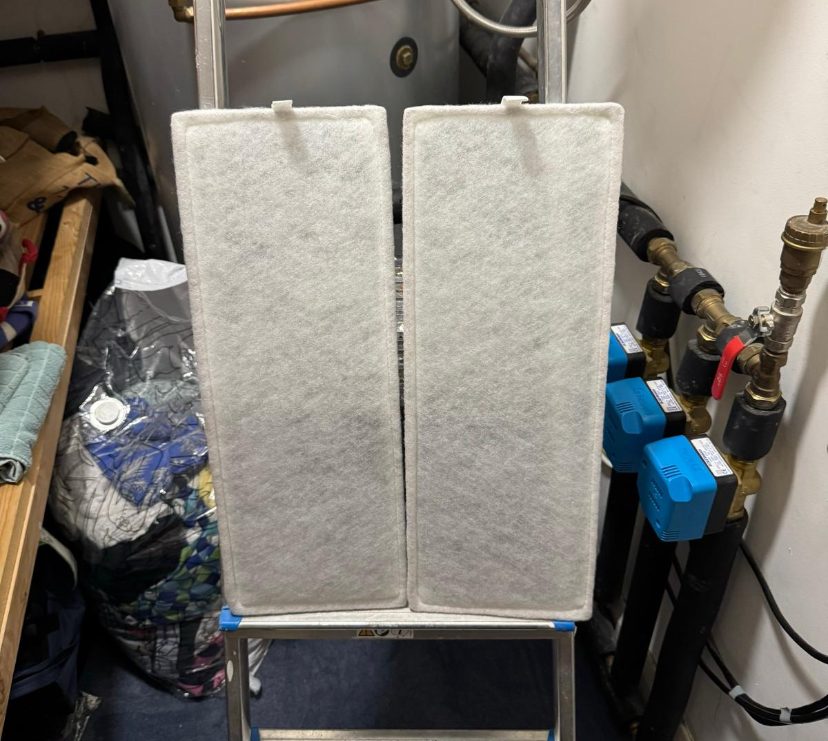
Service it first, then decide. A heat recovery unit that has run for ten years, whether it is a Vent-Axia Sentinel Kinetic, a Kinetic Advance S, an Xpelair or similar, usually feels tired because it has been breathing through blocked filters and dusty valves, not because it is worn out. A proper service puts the filters, valves, condensate drain, fans, settings and airflow right, and it is the quickest way to find out what condition the unit is really in. Replace the unit when the service turns up something it cannot fix: fans that stay noisy or keep failing, controls that have stopped working, parts no longer available for your model, or a unit too small for the house you live in now. Even then, where the ducting is sound, the new unit goes onto the existing duct runs. This is how we make that call when we service, replace and install MVHR systems across Dublin and Leinster.
Key takeaways
- On older MVHR units (many people call them HRV) the first problem is usually dirt: grey filters and dusty valves and grilles.
- A proper service replaces the filters, cleans the unit, valves and grilles, and checks the condensate drain, the fans, the settings and the airflow.
- A service will not fix fans that stay noisy, failing controls, parts no longer available for the model, or a unit too small for the house after an extension.
- Where the ducting is sound, a replacement reuses it: a new unit sized to the house today, clean valves, the system commissioned again.
- A new MVHR unit from us comes with our 5-year warranty, provided that the system is serviced annually by VentSolve throughout the warranty period.
Is your old MVHR worn out, or just choked?
Usually choked. An MVHR runs quietly day and night, so it is easy to forget while the filters, valves and grilles fill with dust. When the filters clog, the fans work harder, less fresh air reaches the rooms, the unit gets louder and the house feels stuffy. When the extract valves in the bathroom and kitchen are coated, the wet air stays in and ends up on windows and cold walls. Those are exactly the symptoms people put down to an old unit failing.
Our recent jobs show it. In an apartment off the Chapelizod Hill Road in Lucan, the filters in a Vent-Axia Sentinel Kinetic Advance S were meant to be white and the valves needed cleaning. We replaced the filters, cleaned the valves, calculated the airflow and commissioned the unit, and the system was running as designed again. In an apartment in Newtown, Dublin 17, an Xpelair unit had filters due for a change and grilles coated in dust; new filters and clean grilles had the air moving freely again. On a Kinetic Advance S we serviced recently, both filters were grey and caked in dust; two new filters and a check of the unit restored full airflow. All three were put right by a service.
What does a proper MVHR service restore?
A proper MVHR or HRV service puts the system back the way it was commissioned, which is a lot more than a new pair of filters. On a service visit we:
- replace the supply and extract filters, which every bit of fresh air passes through before it reaches the rooms;
- clean the inside of the unit;
- clean the extract valves in the bathrooms, kitchen and utility and the supply valves in the rooms, without moving them off their setting;
- check that the condensate drain is clear, because the heat exchange makes water that has to leave the unit;
- check that the fans run smoothly and quietly at normal and boost speed;
- check the controls and the settings;
- check the airflow at the valves against what the house needs, and adjust it where it has drifted.
Afterwards you know where you stand: quiet at normal speed, clear windows in the morning and the right airflow mean the unit has life in it. Our posts on the maintenance an MVHR system needs after installation and how often ventilation systems should be serviced cover the routine between visits; this post is about the decision on an older unit.
Which problems will a service not fix?
Wear, failed parts and a unit that is the wrong size for the house.
- Fans that stay noisy or keep failing. A hum, rattle or grinding that stays once the filters and valves are clean usually points to worn bearings or a tired motor.
- Controls that fail. A fault light that comes back after a reset, a controller that no longer responds, a boost that does nothing.
- Parts no longer available for your model. If a fan, board or controller fails and the maker no longer supplies it, there is nothing to repair the unit with, so we check the part can be had before we recommend a repair.
- A unit too small for the house as it is now. An extension, an attic conversion or an extra bathroom adds rooms the unit was never sized for; it runs flat out, gets noisy and still leaves them short of air. The airflow a home needs depends on its floor area, bedrooms and wet rooms (see our post on the airflow rates MVHR systems need to meet), and no service turns a small unit into a bigger one.
| What you notice | Usual cause | Fixed by a service? |
|---|---|---|
| Stuffy rooms, wet windows in the morning | Blocked filters, dusty valves | Usually yes |
| Steamy bathroom, stale smell | Dirty extract valves | Usually yes |
| Water under or around the unit | Blocked condensate drain | Yes, the drain is cleared |
| Noise that stays after the service | Worn fan bearings or motor | No: a new fan if available, or a new unit |
| Fault light keeps coming back | Failed board or controller | No: a part if available, or a new unit |
| New rooms short of air after an extension | Unit too small for the house now | No: a larger unit, or room units in the extension |
The warning signs themselves are covered in our post on five signs your MVHR needs maintenance.
Repair or replace: how we weigh it
A repair makes sense when one part has failed, the part is available and the rest of the unit is sound. Otherwise a repair leaves you with an old unit that still has its other problems.
- Book the service first, unless the unit is completely dead.
- Quiet, with the airflow right afterwards: keep it and have it serviced every year.
- One fault left and the part available: repair it.
- Parts gone, controls failing or the unit too small: replace the unit and reuse the ducting where it is sound.
- House extended: a larger central unit, or a single room unit in the new rooms; our comparison of MVHR and single room heat recovery for a Dublin semi sets out how we choose.
What does replacing an old MVHR unit involve?
Where the ducting is sound, the unit changes and the house does not. The ducts, valves and outside terminals are built into the ceilings and the attic, so we check them first: joints connected and sealed, no crushed or kinked runs, insulation on any duct through a cold attic, valves and terminals clear. Damaged lengths are repaired or replaced; the rest stays.
The new unit is chosen for the house as it is today and fitted onto the existing duct runs with the condensate drain and controls connected. The valves are cleaned at the same time, and the system is commissioned again: we set and measure the airflow at every valve, balance the supply against the extract, and hand over the measured figures, the same as on a new installation.
In Honey Park, Dún Laoghaire, we replaced an old Vent-Axia Sentinel Kinetic that was due for replacement. The ceiling extract valves were thick with dust and dirt, and valves like that restrict the airflow from the bathrooms and kitchen, so even a brand new unit would have been fighting them from day one. We fitted the new unit and cleaned the valves, so the system could move air freely again, ready to keep the home fresh and dry through the winter.
A new unit from us comes with our warranty: “We provide a 5-year warranty on MVHR units, provided that the system is serviced annually by VentSolve throughout the warranty period.”
What does it cost?
We do not publish a fixed price for a service or a unit change on existing ducting; both depend on the unit, the access and what we find, and we quote them from photos of the unit and its label. Where the ducting has to be replaced too, the job is close to a new installation: our 2026 installed prices for a whole new system are €5,500 to €6,000 for a home up to 100 square metres, €6,000 to €7,000 for 100 to 200, €7,000 to €8,000 for 200 to 300 and €8,000 to €9,500 above 300. A unit change on sound ducting is a smaller job.
Frequently asked questions
How long does an MVHR unit last?
There is no fixed age at which a unit has to go. One that has had regular filter changes and an annual service can run well for many years; one that has run on blocked filters wears its fans sooner. If the fans are quiet, the controls work and the airflow is right once it is clean, it is not due.
Do you service units that were fitted when the house was built?
Yes. Many homes in Honey Park and around Dún Laoghaire, and many newer apartments in Lucan, Clondalkin and Dublin 20, were built with MVHR, and we service or replace those systems. Our recent services include Vent-Axia Sentinel Kinetic Advance S and Kinetic Advance S units and an Xpelair.
Can I just change the filters myself?
Where the unit is designed for it, yes, and between services it is good practice: if you cannot remember the last filter change, it is due. A filter change does not clean the valves, clear the condensate drain, check the fans or check the airflow, and those are the checks that tell you whether an older unit is healthy.
Do I need new ducting with a new MVHR unit?
Not if the ducting is sound. We check the joints, the runs in the attic, the insulation on cold runs and the valves and terminals, repair or replace any damaged lengths and fit the new unit to the rest. The system is then commissioned again, so every valve delivers the airflow the house needs.
What warranty comes with a replacement unit?
We provide a 5-year warranty on MVHR units, provided that the system is serviced annually by VentSolve throughout the warranty period. The annual service also keeps a new unit from ending up where the old one did, with blocked filters, dusty valves and a system that no longer moves the air it was designed for.
Send us a few photos of your unit, its label and the filters with your Eircode and we will email a free preliminary quote within 24 hours, or call (01) 685 6363. You can also use the form below.