
For most Dublin semi detached houses built before the 2000s the honest answer is: single room heat recovery units in the rooms that have the problem, unless you are doing a deep retrofit of the whole house, in which case whole house MVHR is the better system. The two do the same thing at different scales. Both pull stale, damp air out and bring fresh air in while keeping most of the heat, so the house stays dry without the cold draught of an open window. MVHR does it for the whole house through one unit and a duct run to every room; a single room unit does it for one room through a hole in the outside wall. The choice comes down to how airtight the house is, how many rooms have condensation or mould, how much disruption you will accept, and budget. This is how we decide it on a survey.
Key takeaways
- Whole house MVHR suits an airtight house: a new build, or a semi that is being insulated, re windowed and sealed as one project. Our 2026 installed prices run from €5,500 to €6,000 for a home up to 100 square metres, €6,000 to €7,000 for 100 to 200, €7,000 to €8,000 for 200 to 300 and €8,000 to €9,500 above that, with a five year warranty when VentSolve services it annually.
- Single room heat recovery suits the typical 1960s to 1990s semi as it stands: a cold back bedroom, a box room, a bedroom over the garage, a living room that streams. One unit per problem room, one visit each, no ducting, a fraction of the cost of a whole house system.
- Both need the moisture source dealt with first: a bathroom fan that extracts, a kitchen extractor that vents outside, leaks fixed.
- Many of our customers end up with both: a central unit for the upstairs or the whole house, and single room units in the rooms the ducting cannot reach.
- You can open windows with either; you will just find you no longer need to.
What a Dublin semi usually looks like to us
The house we survey most is a three bedroom semi from the 1960s to the 1990s, cavity walls with or without pumped insulation, double glazing fitted some time in the last twenty years without trickle vents, an original bathroom fan that moves little air, a kitchen extractor that recirculates, and an attic with insulation on the floor. The back bedroom over the kitchen or the garage is the cold one; it streams in the morning and grows black spots in the top corners. The house is not airtight (the floors, the attic hatch, the old vents and the chimney all leak air), but the sealed windows have taken away the controlled ventilation it used to have. The problem is in two or three rooms, not the whole house.
Whole house MVHR: what it needs and what it gives
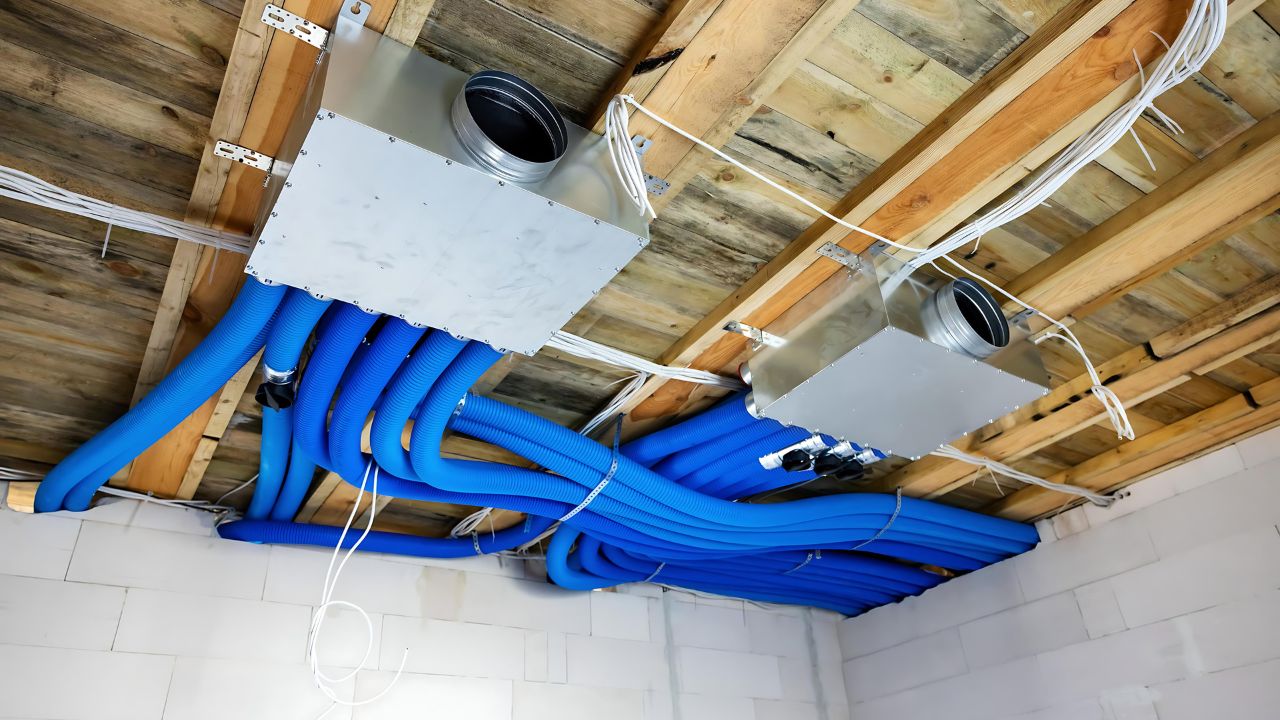
Mechanical ventilation with heat recovery is one unit, usually in the attic, a hot press or a utility room, with supply ducts to the living rooms and bedrooms and extract ducts from the kitchen, bathrooms and utility, and a heat exchanger that passes most of the heat from the outgoing air to the incoming air. It is the right system when the house is, or is about to be, airtight: in a leaky house the heat recovery is undone by the air coming through the gaps, and the duct run through finished ceilings and boxed in corners is the disruptive part of a retrofit. Done as part of a deep retrofit, or in a new build, it gives the best air quality of any system, every room, all the time, filtered. In a retrofit of a standard semi the installation takes about two to three days; Marius Cepas’s public Google review puts it at “installed in just 2 days … very clean and tidy work”, and James Dillon had two systems fitted and “couldn’t be happier with the service”. Our MVHR installation page covers the process from survey to commissioning, and the MVHR cost post explains what moves the price inside the bands.
Single room heat recovery: what it needs and what it gives
A single room unit is a short duct through the outside wall with a ceramic or plate heat exchanger inside, a quiet fan that alternates or runs two streams, and a cover on the inside wall. It ventilates the room it is in, recovers most of the heat, and is controlled from the unit or a phone. Installation is a core drilled hole, a power feed and the unit; one visit per room, no ceilings opened, no ducting. It is the answer for the two or three problem rooms in a house that is otherwise fine, for an apartment where no central system can go, and for a landlord who wants the back bedroom fixed without a project. It does not ventilate the rooms it is not in, so a house with condensation everywhere needs several, or a central system. Marnie McDermott’s public review: “I am very happy with the single room vents that were fitted. The team were very friendly and very tidy.” Our single room heat recovery page lists the units we fit and the current offer of a free axial or inline fan when three units are bought together.
Side by side
| Whole house MVHR | Single room heat recovery | |
|---|---|---|
| Covers | Every room | The room it is in |
| House must be | Airtight, or being made airtight | As it is |
| Installation | About two to three days, ducting through the house | One visit per room, one wall hole each |
| 2026 installed price | €5,500 to €9,500 by floor area | A fraction of a whole house system; quoted per room |
| Best for | New builds, deep retrofits, whole house condensation | Two or three problem rooms, apartments, rentals |
| Maintenance | Filters on the unit, annual service (keeps the five year warranty) | Filter clean on each unit, a few minutes |
The mixed answer we fit most
A great many Dublin semis end up with a central unit for part of the house and single room units where the ducts cannot reach. David Collins’s public review describes it: “The team at Vent Solve installed a central Heat Recovery Ventilator for the upstairs of my house, and individual HRV” units elsewhere. Carol Murray had “Heat Recovery ventilation systems in both bedrooms … They also replaced 2 bathroom fans”, which is the other half of the job: whichever system you choose, the bathroom and kitchen extraction must work or the moisture wins. Where the house has a working central extract system already, an MEV unit in an apartment for example, the question changes; our MEV explainer covers that case.
How we decide on the survey
- Where is the moisture coming from, and is the extraction in the bathrooms and kitchen doing its job? That is fixed first whatever else happens.
- How many rooms have the problem? One to three rooms points to single room units; most of the house points to a central system.
- How airtight is the house, and is a retrofit planned? Sealed and insulated, or about to be, points to MVHR.
- How much disruption and budget? One visit per room against two to three days and a duct run.
- Who lives there? A family with asthma or a baby in the cold back bedroom usually wants that room fixed this week, and a single room unit does that.
We fit both across Dublin and Leinster; the north county work is described on our ventilation installation in Swords page.
Frequently asked questions
Are single room heat recovery units worth it?
In a room that streams and grows mould, yes: it ventilates and keeps the heat without a draught, is fitted in a morning, and fixes the room the problem is in. They are not a whole house solution on their own.
Is it worth retrofitting MVHR?
When the house is airtight or is being insulated and sealed as a project, yes; it is the best air quality you can buy. In a leaky semi that is staying leaky, the money is better spent on the problem rooms and the extraction.
Does a house need to be airtight for MVHR?
It works best when it is. The heat recovery depends on the air going through the unit rather than through gaps in the building.
Can you open windows with MVHR?
Yes. Nothing stops you; most people find they stop needing to.
How much does a single room MVHR cost?
We quote per room from your photographs and Eircode, and it is a fraction of a whole house system. Three units bought together currently come with a free axial or inline fan.
Send us a few photos with your Eircode and we will email a free preliminary quote within 24 hours, or call (01) 685 6363.