
You scrub the mould off the bathroom ceiling. You bleach the grout and wipe down the window frames. Two weeks later, it is back. Damp keeps coming back after cleaning because cleaning only removes what you can see. The mould is the symptom and moisture is the cause, and until the source is dealt with, spores settle on the same damp surface and grow again. In most homes the source is condensation from too little ventilation. Sometimes it is a leak or a cold bridge, and less often rising or penetrating damp. This is how we work out which one a house has on a mould removal job in Dublin, and what makes the result last.
Key takeaways
- Cleaning removes the growth, not the moisture. Wiping mould off a damp wall is like mopping the floor under a dripping tap.
- Condensation from too little ventilation is the cause we find most often, and it gets worse from October to March.
- A leak leaves a defined patch in one place all year; a cold bridge leaves a line that follows the structure; rising and penetrating damp sit low on ground floor walls or show after rain.
- What lasts is ventilation that works, a steadier heating pattern, the repair the building needs and proper treatment of the growth.
- If you have cleaned the same spot more than twice, or cannot tell which source you have, a mould survey is usually the quicker answer.
Why does mould come back after cleaning?
Because the conditions that grew it are still there. Mould spores are everywhere, and they only become a problem on a surface that stays damp long enough for them to grow. A cloth or a bleach spray takes the visible growth off; on plaster, grout, sealant and timber, bleach can lighten the colour but often leaves the growth behind. Our guide to professional mould cleaning versus a shop spray covers where a spray is the right tool and where it is not.
Nothing in a bottle changes the moisture. The US Environmental Protection Agency’s guidance on mould in the home puts it in one line: the key to mould control is moisture control. Mould also grows where nobody cleans, behind furniture, inside wardrobes and in the hot press, so read the signs of a hidden mould problem before you reach for the spray again.
Where is the moisture coming from?
Almost always from one of five places, and the pattern on the wall usually tells you which.
| What you see | Likely source | What fixes it |
|---|---|---|
| Spotting in top corners of outside walls, behind wardrobes and on window reveals; worse in winter | Condensation from too little ventilation | Extraction, background ventilation, steadier heating |
| Spotting on a bathroom ceiling around the fan | A fan that does not extract enough or switches off too soon | A cleaned, replaced or humidity sensing fan |
| A defined patch with a brown ring, in one place, all year | A leak: plumbing, sealant, roof or gutter | The repair, then drying, then treatment |
| A stripe of mould along the top of a window or where the ceiling meets an outside wall | A cold bridge in the structure | Ventilation, and insulation of the cold spot where needed |
| A damp band with white salts low on a ground floor wall | Rising damp, less common than people expect | A builder’s repair, then treatment |
| A patch on an outside wall that grows after wind and rain | Penetrating damp: gutters, render, pointing or sills | The outside repair, then drying and treatment |
Condensation: the most common reason damp keeps coming back
Showers, cooking, clothes drying indoors and breathing all put moisture into the air, and in winter the windows stay shut. When that warm, moist air meets a cold surface it turns back into water, and the coldest surfaces are where mould grows: the glass, the reveals, the corners of outside walls, the wall behind a wardrobe.
Older Irish homes had draughts that gave them some ventilation by accident. Insulation, draught proofing and new windows close those air paths: the house gets warmer and also keeps its moisture in, which is why mould can appear after an upgrade. If your mould is worst in the mornings, in bedrooms with the door shut and in the weeks the washing dries on the radiators, our condensation season checklist is the place to start.
How can you tell a leak, a cold bridge or rising damp from condensation?
By where the patch is, its shape and when it gets worse. Four checks help.
- Watch the timing. Condensation follows cold nights, showers and drying clothes. A plumbing leak follows use, such as a shower upstairs. A roof, gutter or penetrating damp problem follows heavy rain.
- Look at the shape. Condensation mould spreads like a soft cloud in corners. A leak gives a defined patch, often with a brown ring. A cold bridge draws a straight line along the lintel or ceiling junction. Rising damp is a band low on the wall.
- Try the foil test. Tape a square of kitchen foil tight to the damp area, sealing all four edges, and leave it for a day or two. Water on the room side points to condensation; damp underneath points to moisture coming through the wall. It is a home check, not a diagnosis, and many walls have both.
- Measure, do not guess. A simple moisture meter compared against a dry wall in the same room tells you more than touch does.
Leaks and rising damp need a different fix, usually from a plumber, roofer or builder, and we tell you if that is what we find, so you do not pay for ventilation that cannot solve a plumbing problem.
What actually stops damp coming back?
Four things, and most homes need more than one.
Ventilation that works. An extractor in the bathroom and kitchen that really extracts; humidity sensing fans switch on by themselves when moisture rises. Keep trickle vents open, even in January. For one or two problem rooms a single room heat recovery unit is often the fix; for a damp house, positive input ventilation (PIV) suits many older, draughtier homes and MVHR suits well insulated, airtight ones.
A steadier heating pattern. Low and steady does more than short hot bursts. A box room left cold with the door shut has cold walls all day, and cold walls are where the water goes. Pull beds and wardrobes a little away from outside walls.
The repair the building needs. Fix the leak, clear the gutter, replace failed sealant, then let the wall dry fully before anything is painted.
Proper treatment of the growth. Affected surfaces are treated rather than wiped, and anything that cannot be saved, such as mouldy silicone sealant, is replaced. Anti-mould paint is a useful second line on treated surfaces, but it will not solve a ventilation problem on its own. Our mould removal starts from €350 depending on size and scope, and because the whole point is that it should not come back, it carries this written warranty: “We provide a 1-year warranty on our mould remediation work when the customer accepts and completes the full recommended quotation and scope of works. If mould returns within 12 months of completing the work, a VentSolve surveyor will revisit the property and carry out a full assessment. If the investigation confirms that the mould has returned due to an issue with our workmanship or the solution we provided, VentSolve will carry out the necessary remedial work at our own cost.”
A real example: a hot press and a bedroom ceiling in Dublin
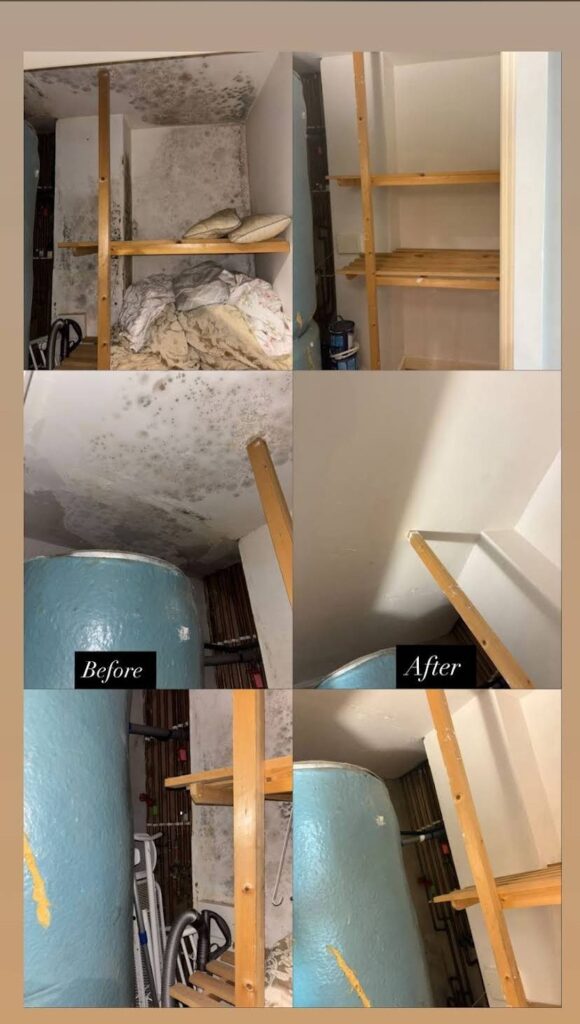
One job in a Dublin home shows the order that makes a result last: a hot press and storage area, plus a bedroom ceiling. In the hot press, black mould had spread across the walls, the shelving and even the cylinder. Hot presses are a classic hotspot: a warm cylinder, a closed door, no airflow and clothes stored inside. Our technician worked fully protected. We looked for the source of the moisture first, then treated the affected surfaces properly, not just wiped them. The result was clean, treated surfaces and a clear plan to stop the moisture. The before and after photos are in our post on mould in the hot press.
When is a mould survey the quicker answer?
When you have cleaned the same spot more than twice, another bottle will not be the answer. Moisture is being produced or trapped somewhere, and a mould survey finds it faster than trial and error. It is the right first step when:
- the mould returns within weeks, or a musty smell stays after scrubbing;
- what you see does not match the table above, or fits two rows at once;
- the mould is in more than one room;
- a landlord, tenant or insurer needs the cause in writing;
- someone in the home has asthma or another chest condition.
A survey takes moisture readings against dry comparison points and checks whether the fans and vents actually move air. Our post on what happens during a professional mould survey walks through each step and the report you get. The survey is a booked visit with its own fee; the preliminary quote from your photos is free.
Frequently asked questions
Why does mould keep coming back after I clean it?
Because cleaning removes the visible growth, not the moisture that caused it. Until the source of the damp is fixed, usually condensation from too little ventilation and sometimes a leak, a cold bridge or rising damp, spores keep landing on the same damp surface and growing again.
Does bleach kill mould permanently?
No. On plaster, grout, timber and sealant, bleach can lighten the colour and leave the growth behind. It does nothing about the moisture either, so on a damp wall the mould usually reappears within weeks, often in exactly the same shape.
Will opening windows fix a damp problem?
It helps. Ten minutes in the morning clears the overnight moisture from a bedroom. It is not a reliable fix through an Irish winter, though, because it depends on the weather and throws away heat. Controlled ventilation gives steady airflow whether or not anyone remembers the window.
What is the best ventilation to stop mould coming back?
It depends on the house. A humidity sensing extractor fan fixes many bathroom problems. Single room heat recovery units suit one or two problem rooms. PIV suits many older, draughtier homes, and MVHR suits well insulated, airtight homes. The age, layout and airtightness of the house decide which.
Can you treat the mould and fix the ventilation at the same time?
Yes. We do both mould removal and ventilation installation, so the existing growth is treated and the moisture source is dealt with as one job rather than two. If the cause turns out to be a leak or rising damp, we tell you, because that repair has to come first.
Send us a few photos of the mould with your Eircode and we will email a free preliminary quote within 24 hours, or call (01) 685 6363, or use the form below.