
A professional mould survey finds out where the moisture is coming from, how far the mould has spread, and what will stop it, and it puts all three in writing. It is not a man with a torch saying “that looks bad”. Over about an hour to two hours in a typical Dublin home we take moisture readings in the walls and the air, check how the ventilation performs, sample the air or the surface where the cause is not obvious, and look at the building around the problem. You get a report with the readings, photographs and a recommendation you can act on, whether you are a homeowner, a landlord, a tenant or a buyer. This is what the visit involves, and when it is worth booking.
Key takeaways
- The survey answers one question above all: where is the water coming from? Mould is the symptom; condensation, a leak, rising damp or failed ventilation is the cause.
- We measure rather than guess: a moisture meter on the affected walls, humidity and temperature in the rooms, and air sampling indoors against an outdoor reference sample where needed.
- Swab or tape samples from a surface tell you what is growing; air samples tell you whether spores are in the air you breathe at a level above outdoors.
- The report sets out the cause, the extent, and the fix in priority order, from a fan or a vent to a full treatment, with the readings behind each recommendation.
- A survey before treatment is why our mould removal carries a one year remediation warranty: we treat the mould and the moisture source together.
Before we arrive
We ask for a few photographs and your Eircode, and we email a free preliminary quote within 24 hours; what the visit covers is also set out on our mould survey in Dublin page. Before the visit it helps to clear access to the worst affected walls and corners, to leave the heating and ventilation on their normal settings for the days before (so we see the home as it is lived in), and to note when the mould appeared and whether it follows the weather, the seasons or a change in the household.
Step one: the walk-through and the history
The surveyor walks every room, not just the one with the black corner. Mould in a back bedroom often has its origin in a bathroom with a weak fan two doors away. We ask about leaks, past floods, previous treatments, how the home is heated, where washing is dried, and how many people live there. We photograph each affected area before anything is touched.
Step two: moisture readings
A moisture meter is pressed to the wall at several heights and positions across the affected surfaces and at comparison points on dry walls. High readings low on a ground floor wall point to rising or penetrating damp; high readings in top corners and behind furniture on outside walls point to condensation; a wet patch with a dry area around it points to a leak. We also record the air temperature and relative humidity in each room, because warm damp air meeting a cold surface is the most common mould engine in Irish housing, and the numbers show it.
Step three: the ventilation check
Many Dublin homes have extraction that looks fine and does nothing. We check whether each bathroom and kitchen fan actually moves air, whether the ducting goes outside or into the attic, whether trickle vents open, and whether the home has any background ventilation at all once the windows have been replaced. In a house with a central MEV or MVHR unit we check the unit is running and the valves are extracting. This step decides more recommendations than any other, because fixing the ventilation is what keeps the mould from returning after treatment.
Step four: air and surface sampling
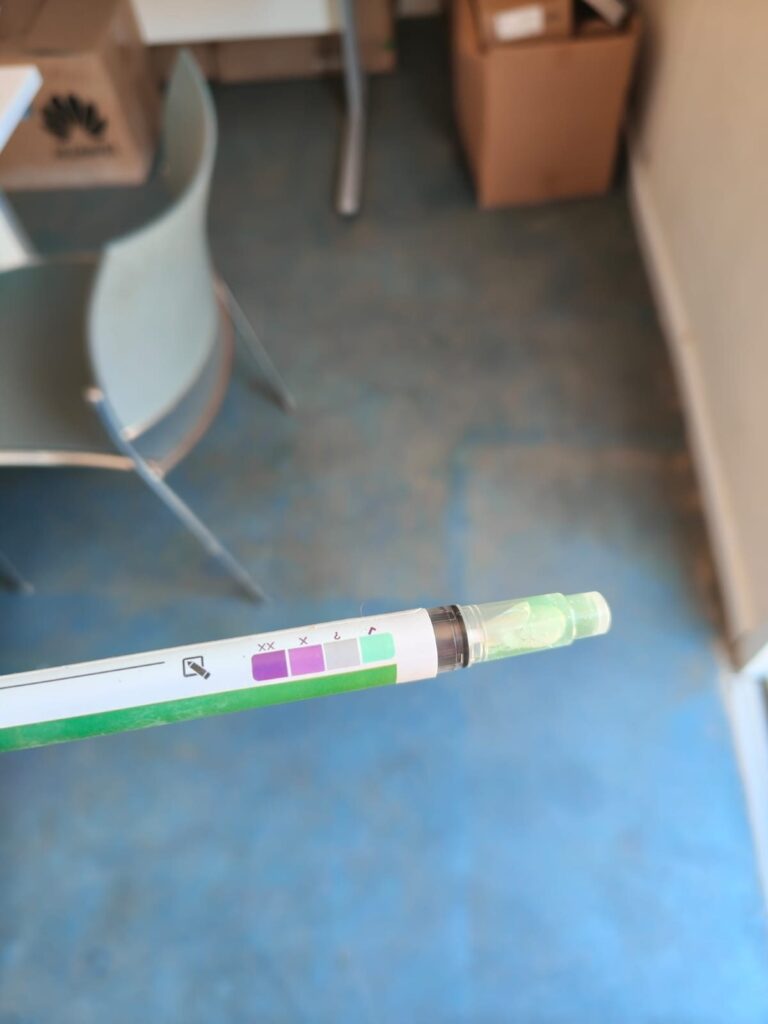
Where the cause is unclear, where someone in the home has breathing problems, or where a landlord, insurer or buyer wants evidence, we sample. For air sampling a pump draws a measured volume of air through a cassette indoors, and a second sample is taken at an open window or outside as the reference, because outdoor air always carries spores and the question is whether indoors is higher. For surface sampling a swab or tape lift is taken from the growth itself. Samples go to a laboratory for analysis and the results come back as part of the report. Our short video on swab testing shows what the surface sample looks like in practice. Our mould testing page explains when testing is worth doing and when a visual survey is enough.
Step five: the building around the problem
The last part of the visit is outside and above: gutters, downpipes, the roof line above a stained ceiling, the ground level against a damp wall, the attic hatch and the attic itself if the stains are upstairs. A blocked gutter or a ducted fan discharging into the attic explains many “mystery” patches.
What the report contains
- Each affected area with photographs, moisture readings and the humidity in the room.
- The likely cause or causes, in plain words.
- How far the mould has spread and whether it is on a hard surface, in plaster or plasterboard, or behind finishes.
- Recommendations in priority order: repairs, ventilation changes, treatment, and what the household can change.
- Where samples were taken, the laboratory results and what they mean.
Sarah Clifford’s public Google review describes the usual sequence: “I had work done recently by this company following a damp survey carried out. I was looked after very well by the team.” Jack Kennedy’s does the same: “The team at Vent Solve came conducted a mold survey report in my house. I opted for a bathroom fan installation.”
When a survey is worth it
- Mould that comes back within weeks of cleaning.
- Mould in more than one room, or on plasterboard, ceilings or behind furniture.
- Anyone in the home with asthma, allergies or a chest condition.
- A rental where tenant and landlord disagree about the cause.
- Before buying or renting a home with a musty smell or stained walls.
- After a leak or flood, to confirm the structure has dried before redecorating.
If the problem is a small patch of black spotting on the tiles around a shower with an obvious cause, you do not need a survey; our post on the signs of a hidden mould problem helps you tell the two apart.
After the survey
Many customers go straight from the report to the fix: a humidity-sensing fan, a vent, a single room heat recovery unit in the cold bedroom, and mould removal of the affected surfaces, which starts from €350 depending on size and scope and carries our one year remediation warranty when the full quoted scope is done. We survey and treat across Dublin and Leinster; the north county work is described on our mould removal in Swords page.
Frequently asked questions
How can I test for mould in my house?
If you can see or smell it, a visual survey with moisture readings usually finds the cause. Air sampling against an outdoor reference and swab samples sent to a laboratory are used when the source is hidden, when health is a concern, or when evidence is needed.
Is a mould inspection worth it?
Yes when the mould keeps returning, affects more than one room, sits on plasterboard or ceilings, or when a tenant, landlord, insurer or buyer needs the cause in writing. A single patch with an obvious cause does not need one.
How do you test for hidden mould in a house?
By moisture readings on the walls, humidity readings in the rooms, checking the ventilation, and air sampling compared with outdoor air. A musty smell with no visible growth is the usual trigger.
What are the symptoms of mould in a house?
Black or grey spotting in corners, around windows and fans, behind furniture on outside walls, a musty smell, peeling paint, and condensation on windows in the morning. Breathing problems that improve away from home are a reason to survey sooner.
How long does a mould survey take?
About one to two hours for a typical home, longer for a large house or where several rooms are sampled. Laboratory results follow after the visit.
Send us a few photos with your Eircode and we will email a free preliminary quote within 24 hours, or call (01) 685 6363.