
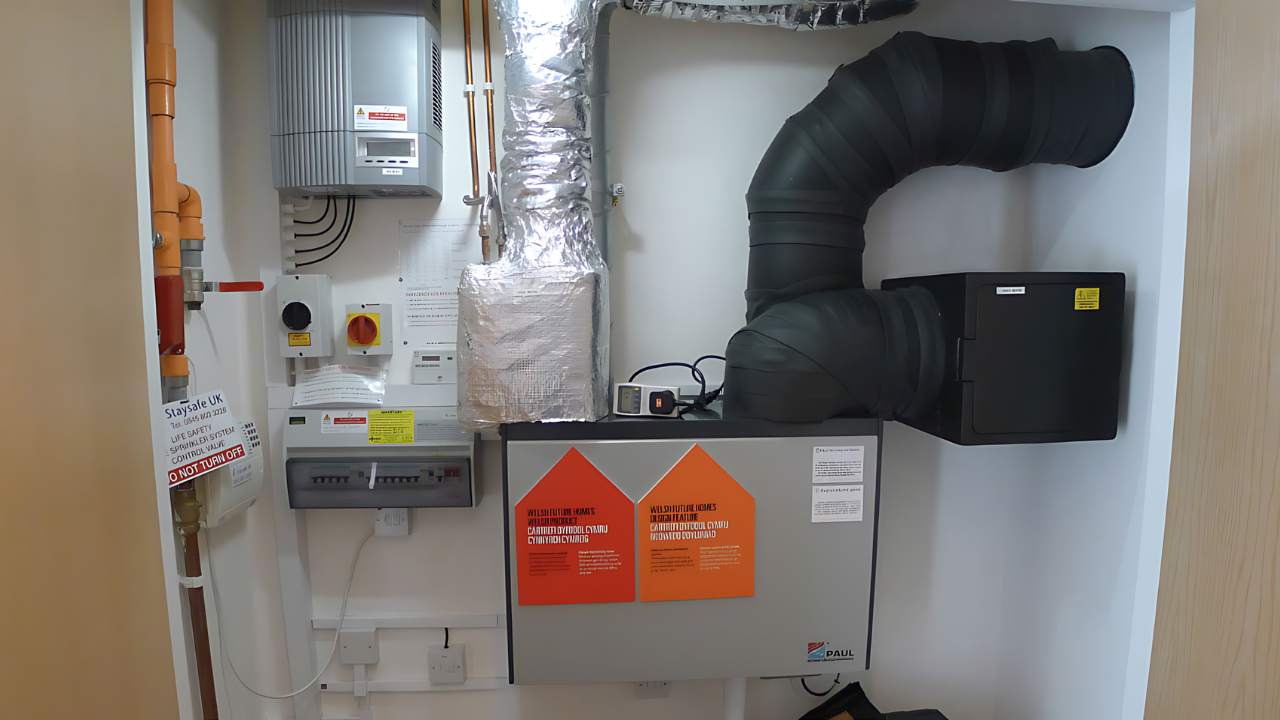
Wondering what an MVHR system will add to your electricity bill before you commit? For most Irish homes the honest answer is a few euro a week, and you can work out your own figure in about two minutes. Below is the sum we use with homeowners, landlords and property managers, a lookup table at 2026 electricity prices, and the parts of the bill people usually forget.
Key takeaways
- A typical whole-house MVHR unit draws roughly 30 to 60 watts continuously, which works out at about €8 to €15 a month at Irish 2026 electricity prices.
- The sum is simple: (watts ÷ 1000) × 24 × 365 × your unit rate in euro per kWh, then divide by 12 for the monthly figure.
- Heat recovery gives back up to around 90 percent of the warmth in your outgoing air, so the small running cost is usually offset by lower heating bills.
- Filter changes, once or twice a year, are the other real cost. A poorly commissioned system left on high speed all day is what pushes bills up, not the technology.
How much does an MVHR system cost to run per month in Ireland?
Most whole-house MVHR units in Irish homes cost between €8 and €15 a month to run on electricity. That covers the fans running 24 hours a day, every day, which is how a mechanical ventilation with heat recovery system is meant to work. It is a continuous, low draw rather than a big appliance switching on and off.
The figure lands in that range because of how a modern unit is built. Systems such as the Vent-Axia Kinetic Advance, the Sentinel Econiq range and the Zehnder ComfoAir Q350 use efficient DC motors, so at normal trickle speed they sip power. Your own number depends on the fan speed your installer sets, the size of your home and what you pay per unit of electricity.
Here is the year-round picture at a working rate of €0.35 per kWh, a reasonable 2026 average for Ireland, though your plan may differ:
| Continuous power draw | Yearly electricity | Roughly per month |
|---|---|---|
| 20 W (efficient, low speed) | about 175 kWh = €61 | about €5.10 |
| 30 W (typical trickle) | about 263 kWh = €92 | about €7.67 |
| 40 W (typical) | about 350 kWh = €123 | about €10.22 |
| 50 W (larger home) | about 438 kWh = €153 | about €12.78 |
| 60 W (high speed, boost-heavy) | about 526 kWh = €184 | about €15.33 |
If you want the wider price picture, including the installation itself, our guide to how much MVHR costs in Ireland breaks down the upfront numbers separately from running costs.
How do you calculate your own MVHR running costs?
You need three numbers: the wattage the unit draws, how many hours it runs, and your electricity unit rate. Then it is one line of arithmetic.
- Annual kWh = (watts ÷ 1000) × 24 × 365
- Annual cost = annual kWh × your unit rate in euro per kWh
- Monthly cost = annual cost ÷ 12
A worked example. Say your unit runs at 40 watts and you pay €0.35 per kWh. 40 ÷ 1000 = 0.04 kW. 0.04 × 24 × 365 = 350.4 kWh a year. 350.4 × €0.35 = €122.64 a year. €122.64 ÷ 12 = €10.22 a month.
Swap in your own two numbers and you have your figure. To find your wattage, check the unit’s spec sheet or its commissioning label for the power draw at the set speed. To find your unit rate, look at the day or 24-hour rate on a recent electricity bill, not the standing charge, which you pay whatever you do. If your home is on a smart or night-saver tariff, the fans run through the cheaper night hours too, which pulls the real average down a little.
What the calculator does not show is the heating side, which is where the money usually comes back. More on that below, and there is a fuller explanation in our guide to how MVHR saves energy in a home.
What affects your MVHR running costs?
Fan speed and commissioning. A system balanced properly to your home’s airflow needs runs at low trickle speed most of the time. A system that was never commissioned, or was set too high to be safe, can run at double the wattage all day. This is the single biggest reason two identical homes get different bills. Correct commissioning is part of a proper install, and it is worth asking any installer to show you the balanced airflow figures.
How often boost kicks in. Bathrooms and the kitchen trigger a higher speed to clear moisture and cooking smells. A busy family home with several showers a day spends more time on boost than a quiet two-person house, and boost can draw 60 to 100 watts while it runs. It is usually only minutes at a time, so the effect on the monthly bill is small.
Your electricity plan. At €0.30 per kWh instead of €0.35, the same 40-watt unit costs about €105 a year rather than €123. Comparing plans is the cheapest way to cut the running cost.
Filter condition. Clogged filters make the fans work harder to move the same air, which quietly raises the wattage. Clean or replace them on schedule and the draw stays where it should. Our note on maintenance after a heat recovery install covers the timing.
The running cost is rarely what customers notice. One homeowner who had two MVHR systems installed by us wrote in a Google review that the whole job took three days and that the pricing was “very competitive compared to others I had contacted”; what he mentioned afterwards was the air, not the bill. Another customer, who upgraded from a demand-controlled system to MVHR throughout the house, left us a five-star review. In both homes the fans run continuously on their normal setting, which is where the figures above come from.
Does heat recovery cancel out the electricity cost?
For most homes, yes: the heating you save is larger than the electricity the fans use. That is the point of the heat recovery part. A good MVHR unit reclaims up to about 90 percent of the warmth from the stale air leaving your house and passes it to the fresh air coming in, so you are not heating cold outdoor air from scratch.
Put the two side by side. The fans might cost you €120 a year. A home that used to lose warm air straight out through trickle vents and open windows can save considerably more than that on heating once the incoming air is pre-warmed, especially a well-sealed or newer build. We will not put a single euro figure on your saving because it depends on your home’s airtightness, insulation and how you heat it. But the direction is clear: the running cost is small, and the recovered heat works against it every hour the system runs.
This is also why MVHR suits airtight homes far better than a positive input ventilation unit, which does not recover heat. If you are still weighing the two, MVHR vs PIV sets out where each one makes sense. If you are planning a system, our MVHR installation page has the installed prices by home size.
What are the other costs beyond electricity?
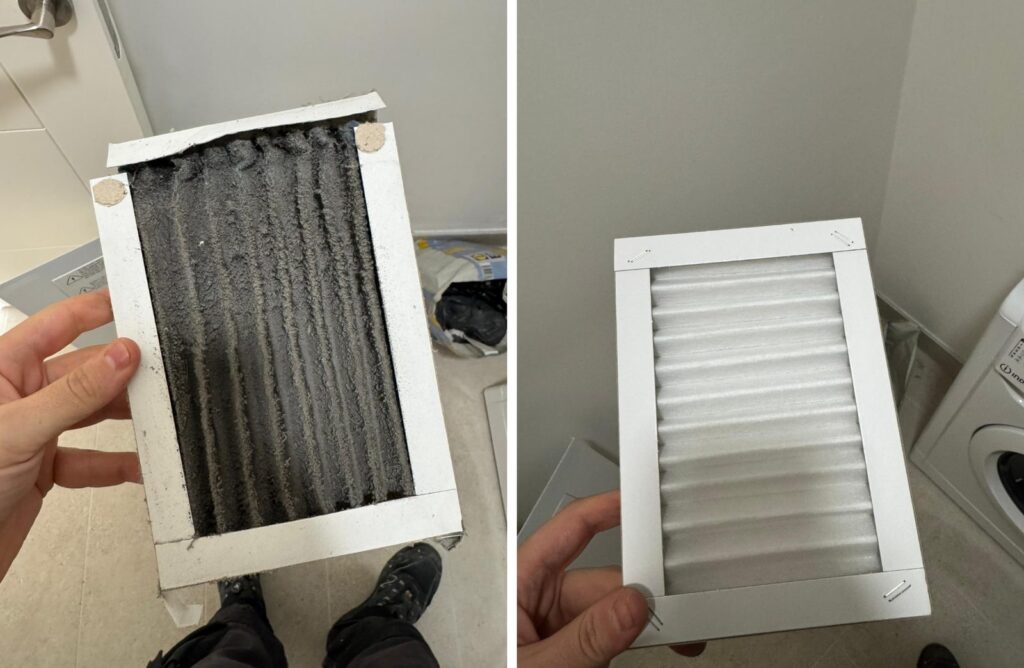
Filters are the main ongoing spend, and they are modest. Filters are changed once or twice a year in most Irish homes, and a replacement set costs far less than a month of heating; we quote the exact filter for your unit. Homes near busy roads or with a lot of pollen may go through them a little faster. Changing them yourself is straightforward on most units.
Beyond filters, a periodic service keeps the system efficient and protects your warranty. VentSolve gives a five-year warranty on MVHR units, provided the system is serviced annually by VentSolve throughout the warranty period, so the yearly service matters. There is more on timing in our guide to how often ventilation systems should be serviced.
Add it all up and a realistic total for a typical home is the electricity, €8 to €15 a month, plus filters once or twice a year and the annual service. For that, you get filtered, fresh, pre-warmed air in every room, with the damp and condensation that feed mould kept in check.
Frequently asked questions
How much electricity does an MVHR system use per year in Ireland?
A typical whole-house MVHR system uses around 260 to 440 kWh a year, depending on fan speed and house size. At a 2026 rate of about €0.35 per kWh, that is roughly €90 to €155 a year, or about €8 to €13 a month. An efficient unit set to a low trickle speed sits at the bottom of that range.
Is it cheaper to run MVHR or a PIV unit?
A PIV unit usually draws a little less electricity because it uses a single fan, but it does not recover any heat, so it can leave your heating bill higher in a well-insulated home. MVHR costs a few euro more a month to run but pays that back by reclaiming warmth from your outgoing air. Our page on what a PIV unit costs to run has the PIV side of the comparison.
Does running MVHR 24 hours a day cost a lot?
No, because the fans draw very little power, often 30 to 50 watts, less than a couple of old-style light bulbs. Running it around the clock is what keeps your air fresh and your home free of condensation, and it still only adds a few euro a week. Switching it off to save money tends to bring back damp and stale air, which costs more in the long run.
How can I lower my MVHR running costs?
Start with the two things that move the bill most: make sure the system was properly commissioned to your home’s airflow so it is not running faster than it needs to, and keep the filters clean so the fans are not straining. After that, compare electricity plans, since a lower unit rate cuts the cost directly. A well set up system should already be running near its cheapest.
Can VentSolve tell me the running cost for my specific home?
Yes. Once we know your unit, its set speed and your electricity rate, we can give you a running cost figure for your own home rather than a range. Call us on (01) 685 6363 or use the contact page.