
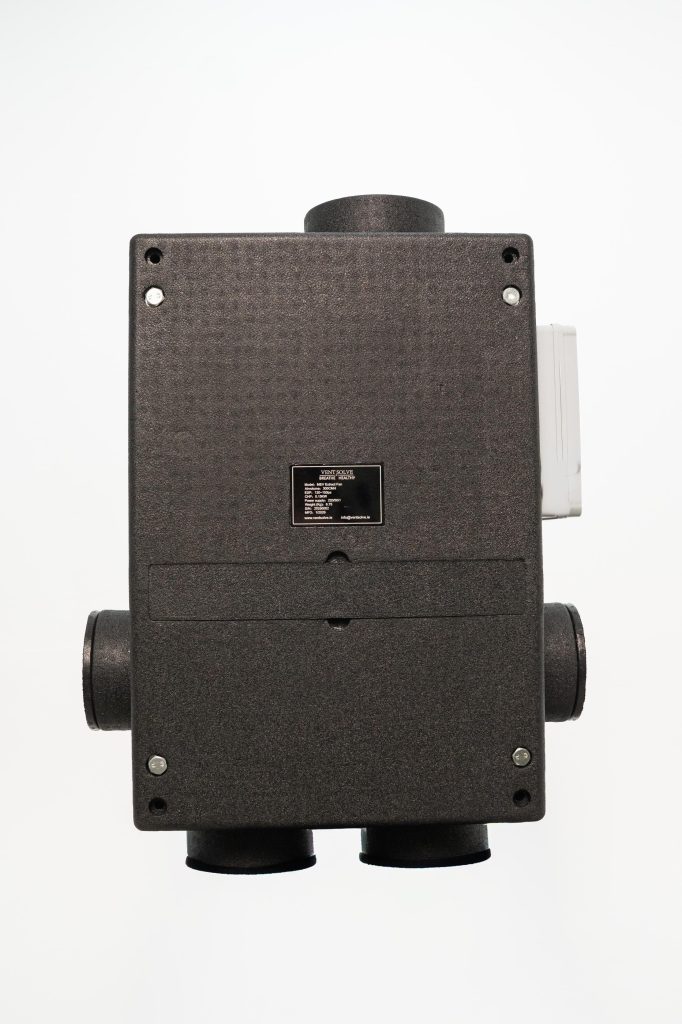
Mechanical extract ventilation, MEV, is the quiet system behind the ceiling in most Irish apartments built since the 2000s and in a lot of houses: one central fan in a cupboard or attic, ducted to the bathroom, en suite, toilet, kitchen and utility room, pulling damp air out all day at a low rate and boosting when someone showers or cooks. Fresh air comes in through trickle vents in the windows or wall vents. When it works, nobody notices it. When the unit dies, which after ten or fifteen years it does, the first sign is condensation on the bedroom windows and black spots in the bathroom ceiling, and the owner often has no idea the system exists. This guide explains how MEV works, the difference between a central unit and decentralised dMEV fans, how it compares with MVHR, how to tell a unit has failed, and what the units cost in 2026.
Key takeaways
- MEV is extract only: one central fan (or a continuous running fan in each wet room, called dMEV) removes damp air continuously; fresh air enters through trickle vents. It does not recover heat.
- It is the standard system in Irish apartments and in many houses because it is cheap to run, needs no supply ducting and meets the building regulations for new homes when designed correctly.
- A failed central unit is one of the most common causes of “sudden” condensation and mould in an apartment. The fix is a like for like unit swap on the existing ducting, usually a half day.
- Central units from our range cost €419 to €549 supply only; continuous running dMEV fans €189 to €219 each. Installed prices depend on access and ducting, so we quote from a photo and your Eircode.
- Choose MEV where the house or apartment has trickle vents and a modest heating bill; choose MVHR where the home is airtight and you want the heat kept.
How MEV works
A central MEV unit is a box with a low energy fan and several duct spigots, mounted in a hot press, utility cupboard, ceiling void or attic. Rigid or semi rigid ducts run from it to a valve in the ceiling of each wet room. The fan runs continuously at a trickle rate, typically well under its maximum, and a humidity sensor or a switch raises it to boost when a shower or cooking lifts the moisture. Because air is always leaving the wet rooms, replacement air is drawn in through the trickle vents in the living room and bedroom windows and across the apartment, so the whole home is slowly flushed. The energy use is small: our Vent Solve MEV silent runs on 40 watts at full output, and sits between 13 and 37 dB(A).
Central MEV against dMEV
A central system has one unit and one place to service. Decentralised MEV, dMEV, puts a continuous running fan in each wet room instead, each with its own humidity sensor, no central ducting. dMEV is the practical choice where there is no room for a central unit or no existing ducting, for example when a house with old on and off fans is upgraded one bathroom at a time. The fans are quiet on trickle and boost by themselves: the S&P EcoAIR EVO HT (€189) draws 2 to 4.5 watts, and the Envirovent Filterless Fan (€219) has no filter to clog and tracks humidity as standard. In an apartment with an existing central unit, a like for like central replacement is almost always cheaper and tidier than converting to dMEV.
MEV against MVHR
Mechanical ventilation with heat recovery supplies filtered air to the living rooms and bedrooms as well as extracting from the wet rooms, and passes the two streams through a heat exchanger so most of the heat in the outgoing air warms the incoming air. That means a second set of ducts, a bigger unit and a higher installed price (our 2026 MVHR prices start at €5,500 to €6,000 for a home up to 100 square metres and are on the MVHR installation page). MEV costs less to buy, is simpler to retrofit and is easier to service, but every cubic metre it extracts is heated air leaving the building, replaced by cold air through the trickle vents. The rule we use: a draughty or moderately insulated home, an apartment with existing MEV ducting, or a tight budget points to MEV; an airtight new build or deep retrofit, or a household that feels the heating bill, points to MVHR. The planning questions for a new build are in our post on planning ventilation before the walls go up.
Signs the MEV unit has failed
- Condensation on the bedroom windows in the morning that was not there a year ago.
- Black mould in the bathroom ceiling corners or around the extract valve.
- No air movement at the ceiling valve: a sheet of toilet paper held to it does not stick.
- A new noise, a rattle or a hum from the cupboard or ceiling, or complete silence where there used to be a faint hum.
- The unit’s light or display is off, or the isolator switch in the cupboard has been turned off by someone who did not know what it was.
In an apartment block the symptoms often appear in several flats at once as units of the same age fail. For a management company or board that is a building wide question rather than a single repair, and we are preparing a separate guide for that case.
What the units cost in 2026
| Unit | Type | Airflow | Noise | Power | Supply only price |
|---|---|---|---|---|---|
| Vent Solve MEV silent, controller included | Central MEV, humidity sensing | 515 m³/h | 13 to 37 dB(A) | 40 W | €419 |
| OZEO E ECOWATT 2 (humidity sensor version) | Central MEV | 330 m³/h | 27 dB(A) | up to 30 W | €489 |
| Vent-Axia Lo-Carbon Multivent MVDC-MS | Central MEV | 425 m³/h | 13 to 37 dB(A) | 44 W | €524 |
| DucoBox Silent Connect | Central, demand controlled | 400 m³/h | 46.5 dB(A) at full output | 84 W at full output | €549 |
| S&P EcoAIR EVO HT | dMEV fan, humidity sensing | 108 m³/h | 9 to 34.6 dB(A) | 2 to 4.5 W | €189 |
| Envirovent Filterless Fan | dMEV fan, humidity tracking | 198 m³/h | 12 dB(A) on trickle | 28 W | €219 |
Prices include VAT. Installed prices depend on where the unit sits, whether the existing ducting can be reused and the state of the valves, so we quote after seeing a photo of the unit and its cupboard. The full range is in our MEV units and decentralised MEV categories.
What we do on a replacement
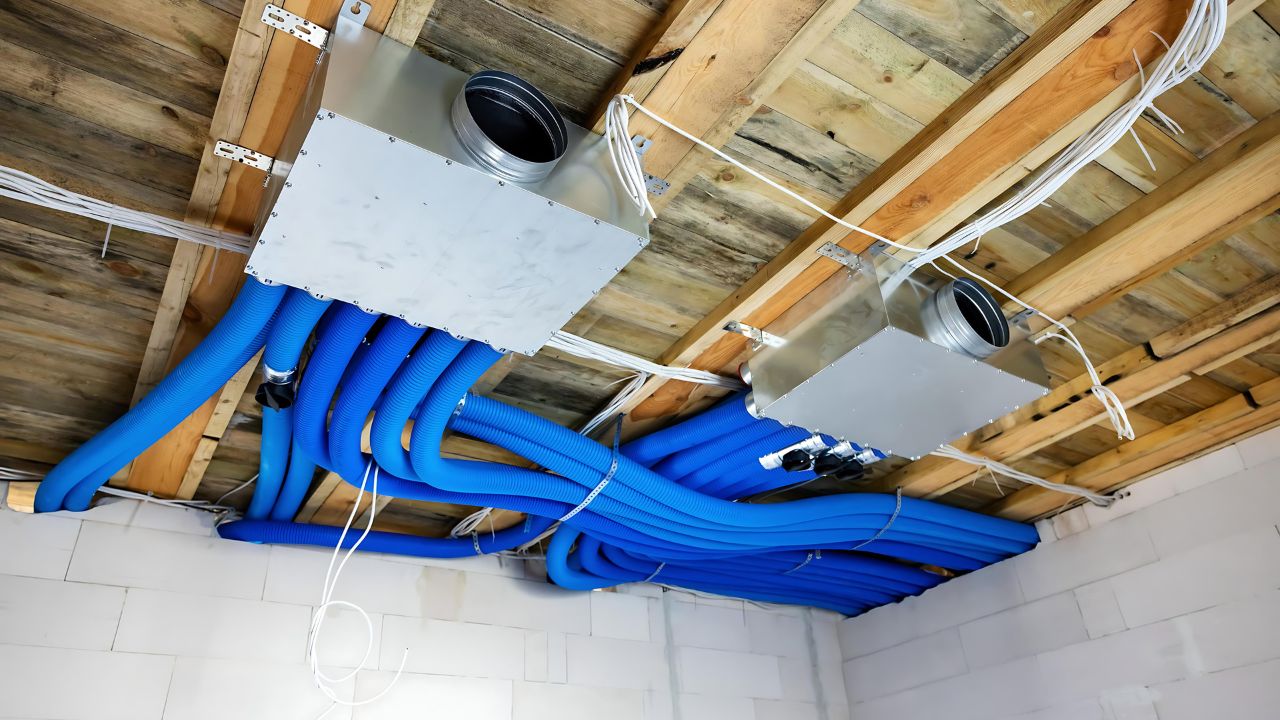
Isolate the power, photograph the existing duct connections, remove the old unit, check each duct for crushing or disconnection where it meets the valve, fit the new unit on the same spigots with new seals, set the trickle and boost rates for the number of wet rooms, test the airflow at every valve, and show you the controller. In most apartments that is a half day with no making good. Where the ducting has collapsed or was never connected, which we find more often than people expect, we tell you before we start, with photos.
Frequently asked questions
What is MEV ventilation?
Mechanical extract ventilation: a continuously running system that pulls damp air out of the bathrooms, kitchen and utility room, either through one central ducted unit or through a continuous running fan in each wet room, while fresh air enters through trickle vents.
What is the difference between MEV and MVHR?
MEV only extracts and does not recover heat. MVHR extracts and supplies, and recovers most of the heat from the outgoing air, at the cost of more ducting and a higher installed price.
What are MEV units?
The central fan units that drive a ducted extract system, such as the Vent Solve MEV silent, the OZEO E ECOWATT 2 or the DucoBox Silent Connect. Each has several duct connections and a humidity sensor or controller.
Can MEV be installed in an existing home?
Yes, with a survey to plan the duct routes. In homes without space for ducting, dMEV fans in each wet room give the same continuous extraction without the central unit.
Is MEV expensive to run?
No. One low energy central fan costs less to run than separate extractor fans in every wet room, and standard MEV units have no filters to replace.
If your apartment or house has an MEV unit that has gone quiet, or condensation that arrived out of nowhere, send us a photo of the unit and your Eircode and we will email a free preliminary quote within 24 hours, or call (01) 685 6363. The service page for MEV ventilation in Dublin has the details of what we install.