
Positive input ventilation is the system people are usually offered when a house has condensation on every window in winter and nobody wants ductwork. A single unit sits in the loft, draws air through a filter and pushes it gently into the landing, and the damp air in the house is diluted and nudged out through the gaps, vents and extractor fans it already has. It is simple, cheap to run and often effective in the right house. It is also sold into houses where it cannot work, which is where the “PIV does nothing” stories come from. This guide explains how it works, where it fits in an Irish home, what it will not do, and the two alternatives we fit when it is the wrong tool.
Key takeaways
- PIV is a supply only system: it pushes filtered air in and relies on the house leaking it out. It suits older, draughtier houses with a loft and with condensation on windows and walls across the house.
- It does not recover heat, it does not extract from the bathroom or kitchen, and it does not ventilate an airtight new build properly. Those homes need extraction or heat recovery.
- The loft does not get damp from a PIV unit; the unit draws air from a loft that must already be ventilated at the eaves, which a survey checks first.
- Running costs are low, a few watts of fan plus the heating of the incoming air in winter. The details and 2024 figures are in our PIV running cost post.
- If one or two rooms are the problem, a single room heat recovery unit through the wall usually does more for the same money. If the whole house is damp and sealed, whole house MVHR is the answer.
How a PIV unit works
The unit is a box with a fan and a filter, fixed to the loft floor or hung from the rafters, with a diffuser in the landing ceiling below. It runs continuously at a low rate, drawing air from the loft space (which is outside air, already warmed a little by the roof), filtering it, and pushing it down into the hallway. That slight positive pressure forces the air that is already in the house, warm and damp, outwards through trickle vents, bathroom fans, letterboxes and the gaps around windows and floors. Instead of moisture sitting still on the coldest surfaces, it is diluted and moved on. Most units have a small heater element to take the chill off the incoming air on cold nights, and a sensor that slows the fan when the loft is warm in summer.
Which houses PIV suits
PIV works best in the houses it was designed for: older Irish semi detached and terraced homes with a cold loft, natural draughts, single glazing or old double glazing, and condensation that appears on windows and in corners all over the house rather than in one room. In that type of house there are enough leakage paths for the pushed in air to leave, and the problem is usually a general excess of moisture rather than one wet room with no extraction. Apartments can take a wall mounted PIV version if there is an external wall and no loft, but the case is weaker because apartments are tighter.
Where it does not work
- Airtight new builds and deep retrofits. Since the 2019 building regulations new houses are built tight on purpose. There is nowhere for the pushed in air to escape, so the unit achieves little and the house still needs designed extraction. These homes are built for MVHR or MEV, and we explain the difference in our MVHR vs PIV comparison.
- A single wet room with no extraction. A bathroom that fogs after every shower needs the steam removed at source. PIV dilutes the house; it does not pull steam out of a bathroom. The fix is a proper extractor fan or a single room heat recovery unit.
- Houses with a damp source. Rising damp, a leaking gutter, a bridged cavity or a wet chimney breast are not condensation and no amount of ventilation cures them. This is the first thing a survey rules out.
- Cold feel in winter. PIV pushes outside air into the landing. With the heater element it is tempered, without it some households find the hallway cooler and switch the unit off, at which point it does nothing.
What a survey checks before we recommend PIV
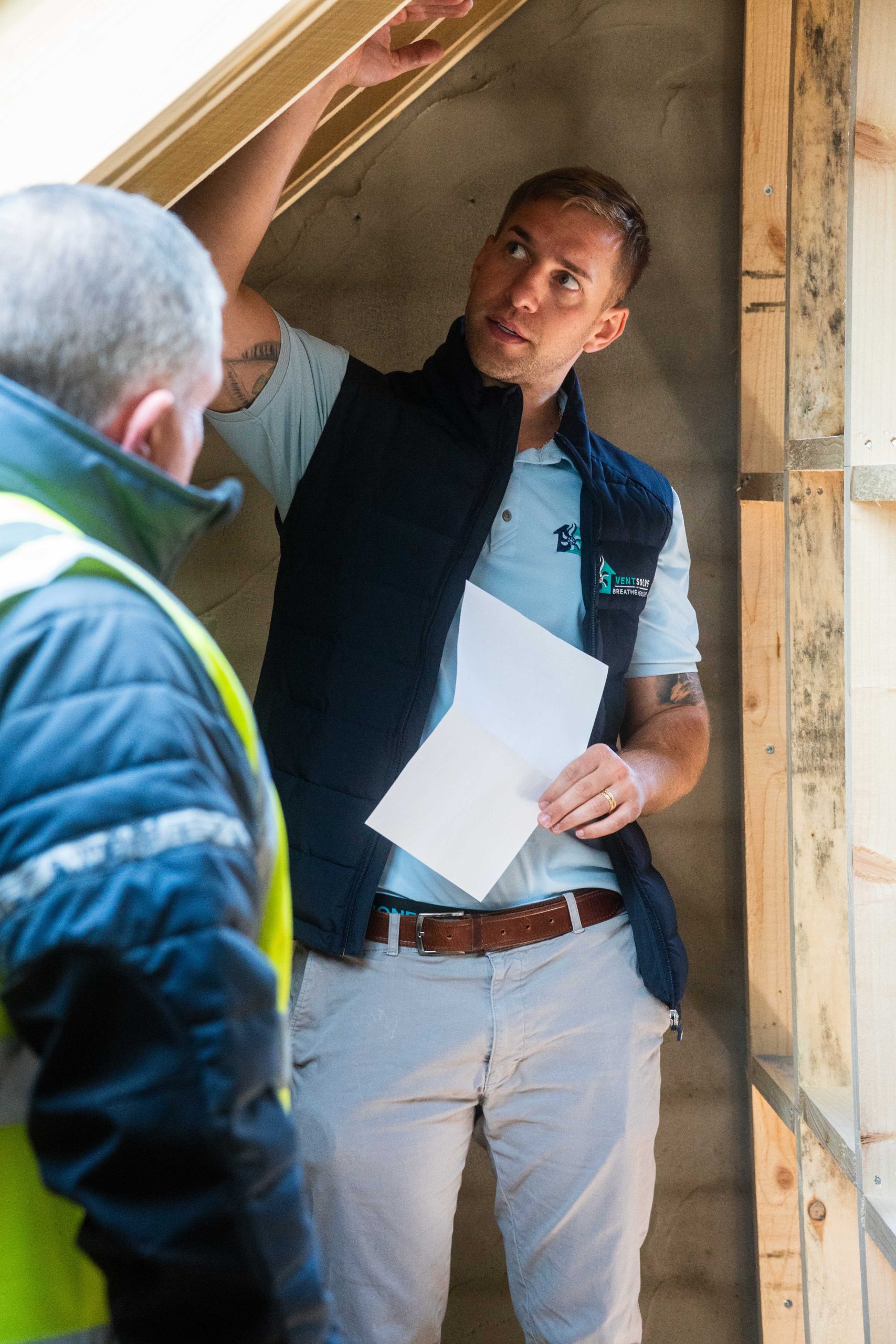
Before anyone sells a PIV unit, three things should be checked. First, is the moisture really condensation rather than a leak or rising damp: a moisture meter and a look at the pattern on the walls tell the story. Second, is the loft ventilated at the eaves and clear of insulation over the vents, because the unit will be breathing that air. Third, do the bathroom and kitchen have working extraction, because PIV complements extraction, it does not replace it. Our mould survey in Dublin covers all three and gives a written recommendation, which may be PIV, may be a fan, and may be a heat recovery unit.
PIV, single room heat recovery and MVHR compared
| PIV | Single room heat recovery unit | Whole house MVHR | |
|---|---|---|---|
| What it does | Pushes filtered air in through the loft, house leaks it out | Ventilates one room through the wall, recovers most of the heat | Extracts from wet rooms, supplies living rooms, recovers heat, whole house |
| Best for | Older draughty houses with general condensation | One or two damp rooms, apartments, extensions | Airtight homes, new builds, whole house damp |
| Heat recovery | No | Yes, up to 81 to 97 percent depending on the unit | Yes |
| Disruption | A loft unit and a ceiling diffuser | One core hole per room | Ducting through the house |
| Where it fails | Airtight houses, single wet rooms | Several damp rooms (cost adds up) | Leaky houses, where heat recovery is wasted |
Single room units and whole house MVHR are what we install most. For prices and the units themselves see the single room heat recovery page and the MVHR installation page.
What PIV costs to run
A PIV fan draws only a few watts, and the heater element runs only on cold nights, so the electricity is small. The real running cost is the heat that leaves with the air you push out, which a heat recovery system would keep. We set out the numbers in our post on how much a PIV unit costs to run. The filter needs changing roughly every few years depending on the unit and the loft.
Frequently asked questions
Do PIV systems really work?
In the right house, yes: an older, draughty home with condensation across several rooms usually sees the windows dry within days. In an airtight house or where the problem is one bathroom with no extraction, it does little, and that is where the disappointment comes from.
What is a PIV system?
A positive input ventilation system is a loft mounted fan unit that filters air and pushes it gently into the landing, so the damp air already in the house is diluted and pushed out through vents and gaps.
What are the disadvantages of a PIV unit?
It does not recover heat, it cannot remove steam from a bathroom or kitchen, it needs a ventilated loft or an external wall, the incoming air can feel cool without the heater element, and it does not suit airtight homes.
Do PIV units make the loft damp?
No. The unit takes air out of the loft and sends it into the house, which if anything keeps the loft drier. What matters is that the loft is ventilated at the eaves so the air it draws is fresh, which the survey checks.
Is PIV better than MVHR?
They solve different houses. PIV is the cheaper option for a leaky older house; MVHR is the system for an airtight one and the only one that keeps the heat. The comparison is in our MVHR vs PIV post.
If you are weighing PIV against a heat recovery unit for your house, send us a few photos of the condensation and your Eircode and we will email a free preliminary quote within 24 hours, or call (01) 685 6363. Where a site visit is the right next step, we will say so.